Metal and Food
The taste the tradition assigns to Metal is pungent, and the assignment is about movement rather than about heat. 辛 is the quality that disperses and opens — ginger, garlic, radish, the aromatics that make a closed system move.
金 Jīn · autumn · west
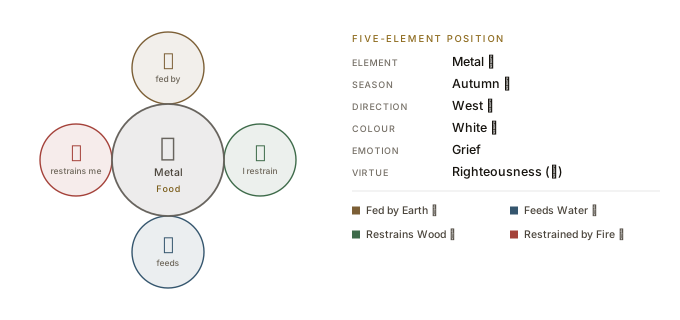
At a glance
Metal's taste is pungent — the quality that opens and disperses, assigned to the phase of the boundary.
In the classical correspondence tables Metal governs autumn and the west, the lung and large intestine, the nose, and the pungent taste.
The taste the tradition gives Metal
That function is why the taste belongs to the phase of the boundary. Metal governs what enters and what is released, and a small amount of pungent food is read as opening the surface and moving what has stagnated. Too much is read as dispersing too far — the classical warning is that excess pungent food scatters qi and damages the moisture the phase depends on.
The grain assigned to Metal is rice, which is the least aromatic and most neutral of the five grains. The pairing is instructive: the taste is dispersing and the grain is settling, so the correspondence is balanced inside itself rather than pointing one way.
What drains Metal in this scheme is dry, scorched and over-spiced food in quantity, which is read as adding dryness to a phase that already governs it. The practical translation is the one that survives scrutiny: if a person is dry, tight and unable to let go, the first thing to reduce is the thing that is drying them out.
What feeds it, what drains it
What feeds it
Aromatics in moderation — ginger, garlic, radish — and rice as the assigned grain. The pattern is opening and dispersing rather than heating.
What drains it
Dry, scorched and heavily spiced food in quantity, and long cooking that removes moisture. Both are read as adding to the phase's own excess.
The Metal table
pungent
rice
dryness
lung
How much weight this carries
Dietary correspondences are the place where five-element thinking is most often confused with nutrition. Metal foods are not automatically good for lung in any medical sense. What the tradition actually does is assign a taste and a temperature to foods and ask whether the chart needs more or less of that quality.
Related Concepts
Common questions
Are pungent foods good for the lungs?
In this system pungent is assigned to Metal, which governs the lung, but the assignment describes a direction — dispersing — not a respiratory benefit.
Why is rice the Metal grain?
Because the five grains are assigned by quality, and rice is the neutral, settling one. The reasoning is dietary, not nutritional.
Should a Metal-heavy person avoid spicy food?
The tradition would say reduce dryness generally, which includes over-spicing. It is a modest claim and consistent with how most people feel after a very dry, hot meal.
Explore more
Want this applied to your own chart?
The database explains the symbol. A reading connects it to your birth data — BaZi, Zi Wei, element balance, and the symbols that keep recurring.
See personalized readings →