Metal and Health
In the classical body map Metal governs the lung and the large intestine, opens into the nose, controls the skin and body hair, and is disturbed by grief. It is the phase of the boundary — what is taken in, what is kept, and what is let go.
金 Jīn · autumn · west
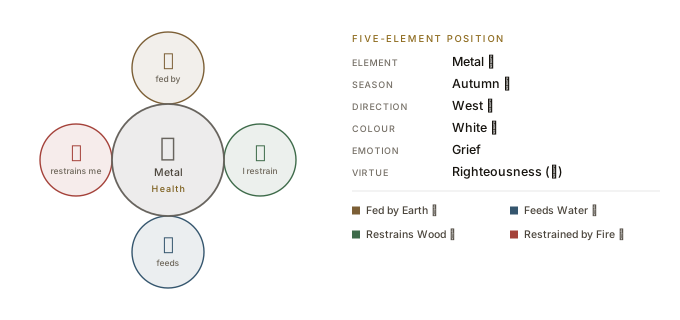
At a glance
In the classical body map Metal governs the lung and large intestine, the nose, the skin, and the emotion of grief.
In the classical correspondence tables Metal governs autumn and the west, the lung and large intestine, the nose, and the pungent taste.
The body map the tradition assigns to Metal
The lung's role here is not the modern respiratory one alone. It is the organ that governs qi at the surface — the defensive layer, the thing that decides what enters. This is why the classical signs of lung weakness include a low voice, a tendency to catch colds, and a specific kind of fragility at the skin, which is read as the boundary failing rather than as the organ failing.
The large intestine correspondence carries the other half of the boundary: letting go. In this system the two organs are one function seen at two ends, and the classical literature links both to grief — the phase that cannot release reads as constriction, and the phase that cannot hold reads as loss.
The dryness correspondence is the most practical item. Autumn air is dry, Metal governs dryness, and the traditional response is to moisten — pears, honey, warm fluids, and fewer drying foods. It is the one five-element seasonal instruction that most people arrive at independently, which is a point in its favour.
Signs of imbalance
Signs of imbalance
A weak or quiet voice; catching cold easily; dry skin, nose or throat; a tendency to constipation or to loose stools; and in the emotional register, grief that will not resolve.
What the tradition recommends
Moistening and protecting the surface: warm fluids, pears and honey, covering the neck in wind, and breathing exercises that emphasise the out-breath. The last one is the phase's own principle applied to itself.
Metal in the body
lung
large intestine
nose
skin and body hair
grief
pungent
How much weight this carries
This is the weakest claim on the site, and it should be stated plainly. The correspondences (lung, large intestine, nose, pungent) are a classical map of relationships between categories, not a description of organs. They were built to organise symptoms, not to diagnose them. Anyone with an actual symptom should see a doctor, and no page here should delay that.
Related Concepts
Common questions
Does a Metal chart mean lung problems?
No. The correspondence groups signs around the boundary function; it does not predict disease. Respiratory symptoms need a doctor.
Why is grief assigned to the lung?
Because grief is the emotion of separation and the lung governs the boundary where separation happens. The assignment is about the shape of the experience.
Why does autumn make people dry?
In this system because autumn is Metal and Metal is dryness. The practical version — the air is drier in autumn — is the same claim without the cosmology.
Explore more
Want this applied to your own chart?
The database explains the symbol. A reading connects it to your birth data — BaZi, Zi Wei, element balance, and the symbols that keep recurring.
See personalized readings →