Heavenly Stem Combinations (五合) and Clashes: Two Rules, One Ring
The ten stems combine with the one five places away and clash with the one six places away. That single piece of arithmetic generates the whole stem layer of a chart — including why two of the ten have no clash partner.
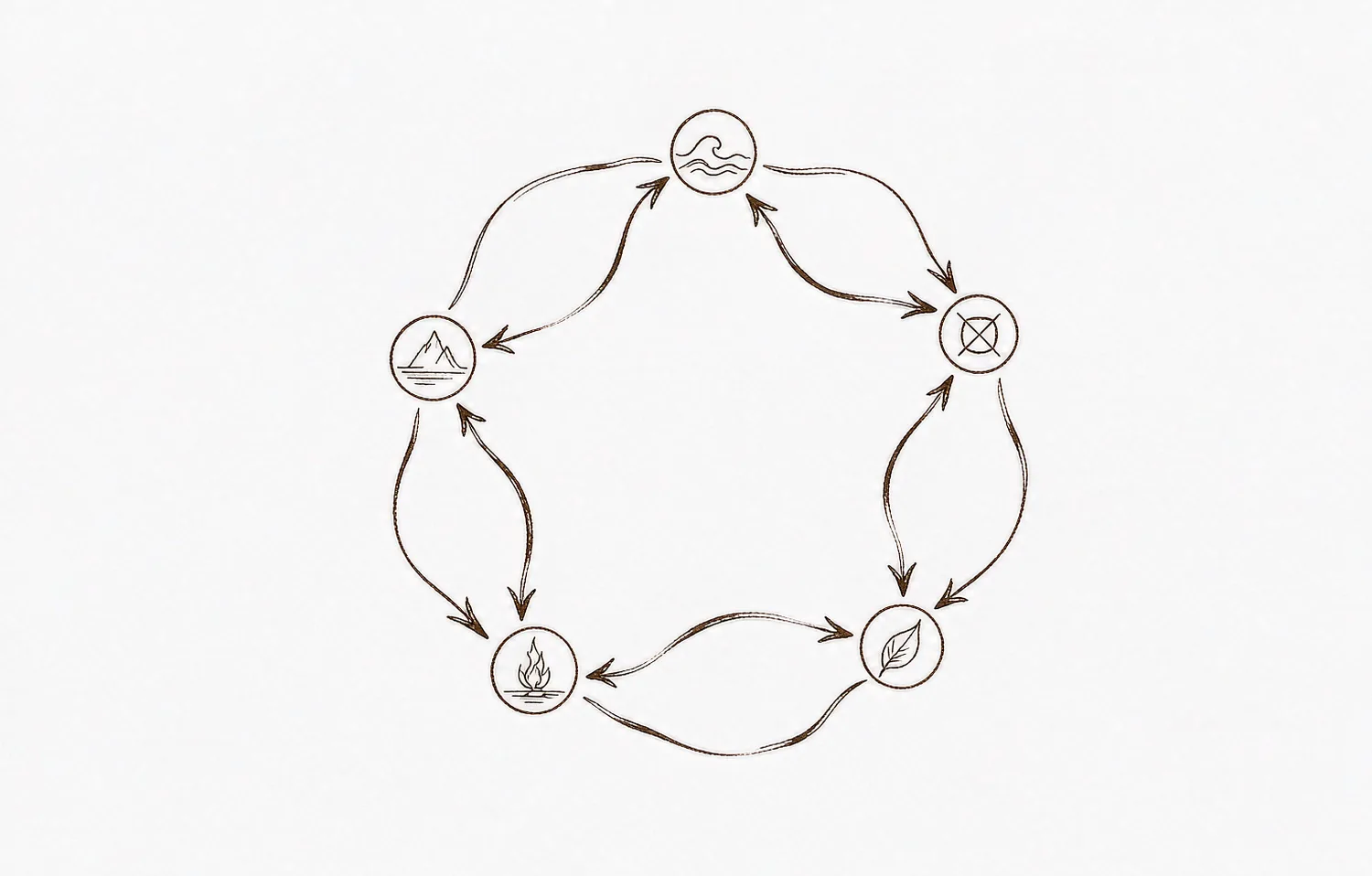
Branch relations get all the attention. Six clashes, six combinations, the trines, the punishments — these are what people learn first, and the branch layer is genuinely where most of the visible action is.
The stem layer is quieter and smaller, and it is also cleaner. Everything in it follows from one fact about a ring of ten characters, and the fact is easy to see once it is pointed at.
The ring
| Stem | Combines with | Clashes with |
|---|---|---|
| 甲 Jia | 己 合 · 化 土 Earth | 庚 冲 |
| 乙 Yi | 庚 合 · 化 金 Metal | 辛 冲 |
| 丙 Bing | 辛 合 · 化 水 Water | 壬 冲 |
| 丁 Ding | 壬 合 · 化 木 Wood | 癸 冲 |
| 戊 Wu | 癸 合 · 化 火 Fire | — |
Lay the ten heavenly stems in their cycle: 甲 乙 丙 丁 戊 己 庚 辛 壬 癸. They alternate polarity — 甲 is Yang Wood, 乙 Yin Wood, 丙 Yang Fire, 丁 Yin Fire, and so on — and each has one of the five elements assigned to it, so each element appears exactly twice.
Every stem relation in the system is a distance on this ring. There are no exceptions and no additional tables to memorise. Two distances matter: five and six.
Combination: five places away
A stem combines with the stem five positions further along the ring. 甲 reaches 己, 乙 reaches 庚, 丙 reaches 辛, 丁 reaches 壬, 戊 reaches 癸 — and then the pattern turns over and repeats.
Each of those five pairs is traditionally assigned a resulting element: 甲己 combines into Earth, 乙庚 into Metal, 丙辛 into Water, 丁壬 into Wood, 戊癸 into Fire. Notice that the five results are the five elements in the order of the generating cycle, which is not an accident.
There is also a visible structural fact in those pairs: every combination joins one Yang stem to one Yin stem. Five is an odd number of steps on a ring of alternating polarity, so parity flips, and a Yang stem always lands on a Yin one. That is why combinations are read as binding rather than opposing — they are pairings across polarity, and the classical language for them is of attraction and union.
Clash: six places away
A stem clashes with the stem six positions further along. 甲 reaches 庚, 乙 reaches 辛, 丙 reaches 壬, 丁 reaches 癸.
Six is an even number, so parity is preserved: 甲 (Yang) clashes with 庚 (Yang). A clash joins two stems of the same polarity, pointing the same way — which is exactly why it reads as opposition rather than attraction. Two Yang forces do not merge; they contend.
And that is where the pattern produces its most quotable result. There is no 戊 clash and no 己 clash. 戊 is five steps from 癸 and 己 is five steps from 甲, but neither has a partner six away that is also in the list of four. The Earth stems sit in the middle of the ring, and the arithmetic leaves them without a clash. Classical sources state this as a rule to be memorised; it falls out of the ring for free.
What it means when a stem combines or clashes
A combination binds. Traditionally the two stems are read as drawn together, and the practical effect is often described as softening whatever each of them was doing — a clash elsewhere in the chart that one of them was driving gets quietened, because the stem now has a partner.
A clash contends. The two stems are read as pulling against each other, and the effect is usually described as loosening whatever each was anchoring. A branch combination that was holding something together can be undone if the stem sitting on top of it is in clash.
Both statements are about relationship, not about outcome. A stem that combines is not rewarded and a stem that clashes is not punished; they are described as being occupied with each other instead of with the rest of the chart.
The argument worth knowing: does it transform?
The significant dispute in the stem layer is what happens after a combination. One position holds that a combination transforms — 甲己 does not merely bind, the two stems actually become Earth, and the chart's element count should be adjusted accordingly. The other holds that a combination only binds, and the stems keep their original elements.
The dividing line is usually conditions. The transform-to-Earth reading is normally granted only when the chart supports it — the right season, the right branch, no competing influence. Without those, most practitioners fall back to binding.
This matters more than it sounds, because the two readings can produce different element balances, and element balance is what the strength judgement rests on. If you meet two readers who disagree about your chart's strength, a transformation argument is a common reason.
The honest position is the same one that applies throughout this site: both are stated conventions, and the question to ask a tool or a reader is which one they follow — not which one is right.
Why the stem layer gets less attention
Two reasons, and both are structural rather than a matter of fashion.
First, scale. There are four stems in a chart against four branches, but the branches carry the seasonal and directional information, and the hidden stems inside each branch can add several more elements. The stem layer is simply a smaller share of the total signal.
Second, and more importantly, the stems are where the ten gods live. The heavenly stems of the four pillars are what the ten-god labels are derived from, which means the stem layer is read mainly as the source of those labels rather than as a set of relations in its own right.
That is not a reason to skip it. It is a reason to read it second — after the branches and the strength judgement, as a modifier that explains why a particular element is or is not doing its job.