The Four Transformations (四化) in Zi Wei
Lu, Quan, Ke and Ji — the mechanism that makes a Zi Wei chart move, and why the same star behaves differently in different years.
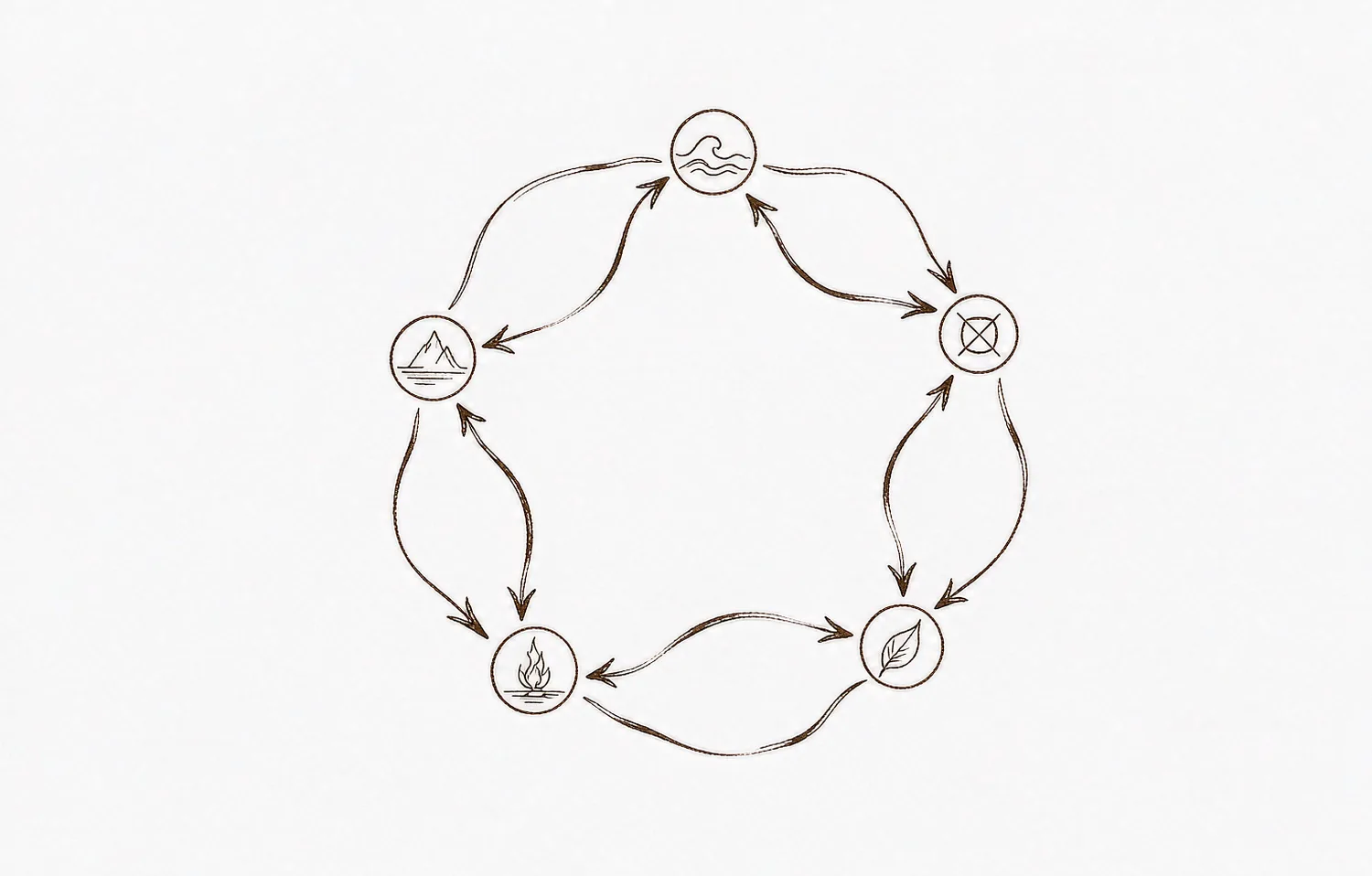
The four transformations (四化) are what turns a static Zi Wei grid into a reading that changes over time. They are derived from the year stem and they mark four specific stars with one of four qualities, which changes how those stars behave.
Without the transformations a Zi Wei chart is a photograph. With them it becomes a sequence, and the system's annual readings depend entirely on this mechanism.
The four
Lu (禄) is prosperity and ease — the star it touches becomes a source of gain or smooth operation. Quan (权) is power and authority — the star becomes a source of influence and control, and also of struggle over it.
Ke (科) is recognition and reputation — the star becomes a source of status, credibility and formal acknowledgement. Ji (忌) is obstruction — the star becomes a point of friction, blockage or anxiety, and it is the transformation practitioners read most carefully.
How they are assigned
Each year stem designates which four of the fourteen stars receive the transformations. For example, a Jia year transforms Lian Zhen with Lu, Po Jun with Quan, Wu Qu with Ke and Tai Yang with Ji.
Because the birth year stem assigns them, every chart carries a fixed set of four from birth — and then the current year's stem assigns a different set, which is how annual readings are produced. The interaction between the birth-year transformations and the current-year ones is where the system's forecasts live.
Why Ji matters most
Of the four, Ji (忌) receives the most attention because it marks a point of obstruction rather than of gain. The classical reading is that the palace holding a Ji-transformed star is where the person will meet friction, and where effort is disproportionately spent.
This is not the same as a prediction of misfortune. The standard interpretation is closer to an allocation of difficulty: this area of life will require more work than the others. Several commentators note that Ji in the Life palace, while demanding, is also associated with people who accomplish things precisely because they could not coast.
Reading them together
The transformations are read as a set, not individually. A star carrying Lu in the Wealth palace and Ji in the Career palace describes earning that flows and work that obstructs — a pattern that would be invisible from either transformation alone.
This is why Zi Wei readings are usually done by an experienced practitioner rather than looked up: the number of combinations across twelve palaces, fourteen stars, four transformations and star brightness is far too large for a table, and the tradition itself is not in full agreement on how much weight each layer carries.