Earth and Food
The taste the tradition assigns to Earth is sweet, and the assignment is not about sugar. 甘 is the taste of grain, root vegetables, and cooked starch — the mild, sustaining flavour that makes up the bulk of a meal rather than the one that finishes it.
土 Tǔ · late summer · centre
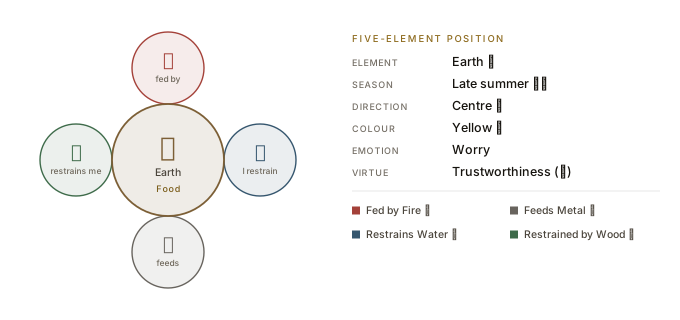
At a glance
Earth's taste is sweet — the mild 甘 of grains and roots, not sugar, and its real medicine is regularity.
In the classical correspondence tables Earth governs late summer and the centre, the spleen and stomach, the mouth, and the sweet taste.
The taste the tradition gives Earth
That distinction is the whole reading. A small amount of 甘 is read as building and harmonising: it is what makes a meal cohere and what the tradition associates with the flesh and the digestion. Too much is read as dampness — the sticky, heavy, slow state that the Earth correspondence produces when it is overfed, and which is exactly what a diet of concentrated sweetness produces.
The grain assigned to Earth is 稷, a millet (setaria) that was the staple of the classical Chinese diet and is now almost forgotten. The point of the assignment is that Earth's food is the ordinary staple, not the treat — which is the opposite of how the sweet taste is used in most modern eating.
What drains Earth in this scheme is raw, cold and damp food in quantity, which the tradition reads as requiring more transformation than the phase can supply, and irregular eating, which removes the rhythm the phase depends on. The practical translation is the most defensible dietary advice in the whole system: eat cooked food, at regular times, in amounts that do not leave you heavy.
What feeds it, what drains it
What feeds it
Cooked grains, root vegetables, and the mild sweet taste of staples rather than of sugar. Regularity matters more than any ingredient — the phase governs rhythm.
What drains it
Raw and cold food in quantity, concentrated sweetness, and eating at irregular hours. All three are read as loads the phase has to carry rather than as nourishment.
The Earth table
sweet
millet (setaria)
damp
spleen
How much weight this carries
Dietary correspondences are the place where five-element thinking is most often confused with nutrition. Earth foods are not automatically good for spleen in any medical sense. What the tradition actually does is assign a taste and a temperature to foods and ask whether the chart needs more or less of that quality.
Related Concepts
Common questions
Does Earth mean I should eat more sweet food?
No — the assignment is to the mild taste of grains and roots, not to sugar. Excess of the sweet taste is read as producing dampness.
Why is millet the Earth grain?
Because it was the classical staple of the central plains, and the correspondence tables assign the five grains by their role in the diet rather than by nutrient content.
Is regular eating really a five-element idea?
It is the Earth principle applied to the Earth organ: the phase governs rhythm, so irregularity is read as a direct load on it.
Explore more
Want this applied to your own chart?
The database explains the symbol. A reading connects it to your birth data — BaZi, Zi Wei, element balance, and the symbols that keep recurring.
See personalized readings →