Earth and Health
In the classical body map Earth governs the spleen and the stomach, opens into the mouth, controls the flesh and muscle, and is disturbed by worry. It is the phase of digestion in the widest sense — not just food, but anything that has to be taken in, broken down, and made usable.
土 Tǔ · late summer · centre
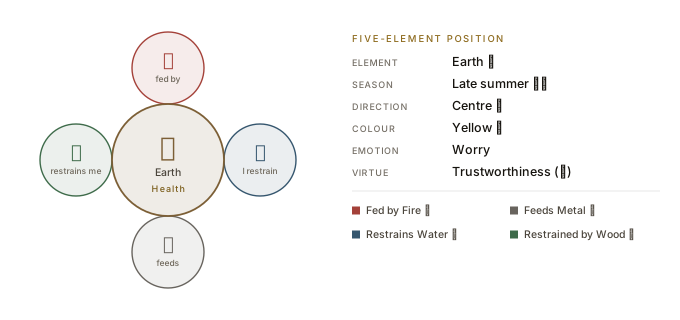
At a glance
In the classical body map Earth governs the spleen and stomach, the mouth, the flesh, and the emotion of worry.
In the classical correspondence tables Earth governs late summer and the centre, the spleen and stomach, the mouth, and the sweet taste.
The body map the tradition assigns to Earth
The spleen's role in this system is transformation and transport: it turns what arrives into something the body can use and moves it where it is needed. When the tradition describes spleen deficiency it is describing a failure of conversion — tiredness after eating, loose stools, a heavy feeling, and a mental fog that is specifically about not being able to organise thoughts.
The mouth and the flesh follow the same logic of intake and substance. Earth is the phase that gives the body its material, so the tissues it governs are the bulky ones, and the classical signs of imbalance include either a lack of flesh or an excess of it — the same failure of conversion read at two extremes.
The damp correspondence is the most practically useful item on the page. Dampness in this system is what happens when transformation fails: things sit, they become heavy, and the whole system slows. The traditional response is to reduce what is hard to process — raw, cold, sweet, and rich — which is also, unhelpfully, most of what people reach for when they feel tired.
Signs of imbalance
Signs of imbalance
Tiredness that arrives after eating; a heavy or foggy feeling; loose stools; a coated tongue; water retention; and a specific kind of mental sluggishness that is about organising rather than remembering.
What the tradition recommends
Warm, cooked, simple food in regular amounts; less raw and cold; and eating at consistent times. The single most repeated piece of advice is regularity, which is the phase's own principle applied to itself.
Earth in the body
spleen
stomach
mouth
flesh and muscle
worry
sweet
How much weight this carries
This is the weakest claim on the site, and it should be stated plainly. The correspondences (spleen, stomach, mouth, sweet) are a classical map of relationships between categories, not a description of organs. They were built to organise symptoms, not to diagnose them. Anyone with an actual symptom should see a doctor, and no page here should delay that.
Related Concepts
Common questions
Does an Earth chart mean digestive problems?
No. The correspondence groups a category of signs around conversion; it does not predict disease and does not replace a diagnosis.
Why is worry assigned to the spleen?
Because worry is what the phase does when it is holding several things at once, and the tradition reads chronic worry as a load on the organ of processing.
What is dampness in this system?
The state that results when transformation fails — heaviness, sluggishness, and a sense of things not moving. It is a description of a pattern rather than a substance.
Explore more
Want this applied to your own chart?
The database explains the symbol. A reading connects it to your birth data — BaZi, Zi Wei, element balance, and the symbols that keep recurring.
See personalized readings →