Earth and the Season
Earth's season is 長夏, 'long summer', the late-summer stretch that belongs to no single month in the Western calendar. It is the phase that takes the eighteen days at the end of each of the four seasons — the handover, when one phase is ending and the next has not started.
土 Tǔ · late summer · centre
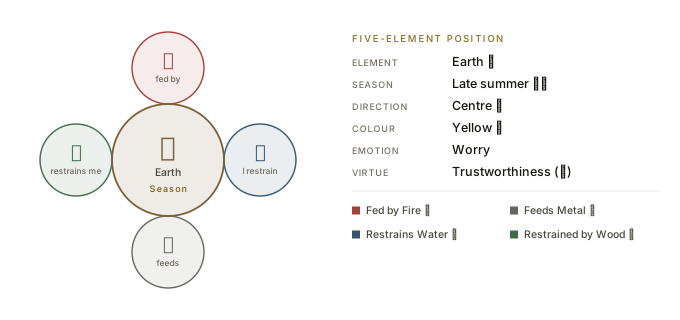
At a glance
Earth governs 長夏 — not one season but the handover at the end of all four, which is why it has four branches.
In the classical correspondence tables Earth governs late summer and the centre, the spleen and stomach, the mouth, and the sweet taste.
Earth and late summer
This is the least intuitive assignment in the system and the one that explains the most. Earth is not a season the way Wood and Fire are; it is the transition between seasons, which is why its branches are 辰, 未, 戌 and 丑 — the last month of spring, summer, autumn and winter respectively. Four characters instead of two, because Earth is present at every handover.
The practical reading is that Earth governs the periods when nothing is clearly happening. Late August, the week between Christmas and the new year, the gap after a project ends — the tradition treats these as Earth time, and treats them as necessary rather than as dead space. A chart that cannot tolerate a transition is a chart with an Earth problem.
For a person, the correspondence is about the middle of a cycle rather than the start or the peak. Earth-heavy charts tend to be most themselves when things are steady and least comfortable at the boundaries — which is why the same person can be excellent at running something and anxious about the decision to start or stop it.
What the season asks of you
What the season asks of you
To consolidate. The classical instruction for 長夏 is to take what the earlier seasons produced and make it durable — which is why the phase is associated with harvest in the sense of storage rather than of gathering.
The month boundaries
辰, 未, 戌, 丑 — the last month of each season, each beginning around the 5th to 7th of the month. A birth in one of these four months has Earth as its month branch, which is a common and often missed contribution.
The season in correspondences
late summer
長夏
damp
5 and 10
How much weight this carries
The seasons are the original evidence for the whole scheme — the cycle was read off the year before it was ever applied to a person. That is also its limit: a season is a phase everyone passes through, while a chart is a particular arrangement of phases.
Related Concepts
Common questions
Why does Earth have four months instead of two?
Because Earth is the phase of transition and every season hands over through an Earth month. It is the structural reason the element sits at the centre.
Is a late-summer birth Earth-heavy?
The month branch is Earth, which is a real contribution, but the day master and the rest of the chart can outweigh it.
What is 長夏 exactly?
A stretch of roughly eighteen days at the end of summer in most reckonings, and in the branch system the four handover months. The two definitions coexist in the classical literature.
Explore more
Want this applied to your own chart?
The database explains the symbol. A reading connects it to your birth data — BaZi, Zi Wei, element balance, and the symbols that keep recurring.
See personalized readings →