Water in a BaZi Chart
Water appears in a chart as the heavenly stems 壬 and 癸, and as the earthly branches 亥 and 子. The pair of stems is the clearest example of the phase's range: 壬 is an ocean and 癸 is rain, and they are the same element at different scales.
水 Shuǐ · winter · north
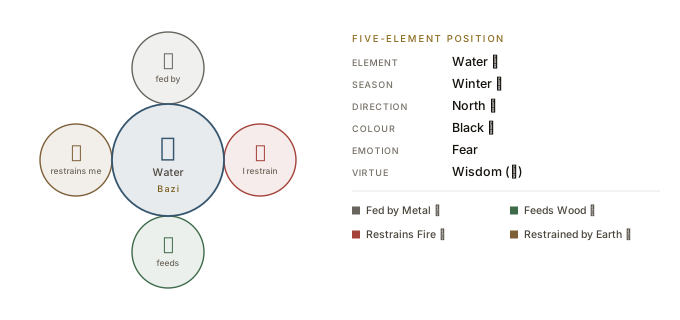
At a glance
Water appears in a chart as the stems 壬 and 癸 and the branches 亥 and 子 — the ocean and the rain, the peak and the first winter.
In the classical correspondence tables Water governs winter and the north, the kidney and bladder, the ears, and the salty taste.
How Water appears in a chart
壬 is yang Water: the sea, the river, the thing that is large and unstoppable and has no shape of its own. 癸 is yin Water: rain, mist, dew, the thing that reaches everywhere and is easy to miss. A chart with 壬 prominent reads as force; the same chart with 癸 reads as penetration. Practitioners treat the substitution as a different chart.
The branches carry the season. 亥 is the first winter month, yang, and contains hidden Wood — which is why 亥 is the Water branch that can generate rather than merely store. 子 is the peak, pure Water and the darkest character in the cycle. A Water stem rooted in 子 is as strong as a stem gets; the same stem on 午 — the Fire branch directly opposite — is being evaporated and reads as present but unable to hold.
As a day master, Water is the self as depth. A 壬 day master is described as expansive, adaptable, and hard to contain; a 癸 day master as perceptive, quiet, and easy to underestimate. The caution is the same as for every day master: one character in eight.
Stems, branches, and the day master
The stems
壬 yang Water: the sea and the river, force without shape. 癸 yin Water: rain and mist, penetration without weight. The pair is about scale rather than strength.
The branches
亥 the first winter month, yang, storing Wood. 子 the peak, pure Water. Rooting in either makes a Water stem strong; 巳 and 午 evaporate it.
As a day master
Read as the self as depth. A 壬 day master moves; a 癸 day master seeps. What the chart supports decides whether either reaches anything.
The Water characters
壬 Rén (yang), 癸 Guǐ (yin)
亥 Hài (pig), 子 Zǐ (rat)
1 and 6
羽 yǔ
How much weight this carries
This is the most technical page in the set and the most falsifiable: either a chart contains Water characters or it does not. What is not falsifiable is what those characters mean — that part depends on the practitioner, the school, and the question being asked.
Related Concepts
Common questions
How do I know if I am a Water day master?
Look at the stem above your birth day, not at your birth year — the year gives the animal, the day gives the self. Converting a date to the solar calendar is the part most people need help with, and the calculator here does it.
Is 壬 stronger than 癸?
It is larger, not stronger. 壬 moves things; 癸 gets into them. Which is preferable depends on what the chart needs.
What does it mean to have no Water in a chart?
That the phase is supplied by luck cycles rather than by the birth chart. It is common and not a defect — charts are read for balance.
Explore more
Want this applied to your own chart?
The database explains the symbol. A reading connects it to your birth data — BaZi, Zi Wei, element balance, and the symbols that keep recurring.
See personalized readings →