Balancing Wood
Balancing Wood does not mean adding Wood. It means checking three things in order — whether the phase has support, whether it has structure, and whether it has an outlet — and adjusting the weakest of the three. Most Wood problems are problems of the second and third, not the first.
木 Mù · spring · east
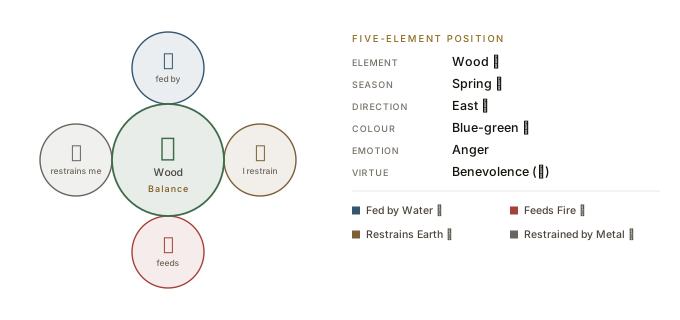
At a glance
Balancing Wood means giving it support, structure, and an outlet — not adding more Wood.
In the classical correspondence tables Wood governs spring and the east, the liver and gallbladder, the eyes, and the sour taste.
What balance means for Wood
Support is Water: reserves, rest, the thing that makes growth possible. A Wood chart without Water is the classic picture of effort without fuel — busy, brittle, and running on willpower. The correction is unglamorous and slow: sleep, savings, and fewer commitments, in that order.
Structure is Metal: limits, rules, and the willingness to be cut back. Wood without Metal overgrows, which reads as rigidity rather than as strength. The correction is not punishment but boundary — a smaller container with clearer walls, applied consistently, including to the person who set it.
Outlet is Fire: something the growth is for. Wood with support and structure but no outlet becomes self-referential, growing for its own sake. Fire in practice means output — finished work, an audience, a deadline that someone else can see. The three together are the whole of the balancing logic, and none of them is a product.
Too strong, too weak, and the fix
Too strong
Prune with Metal and spend with Fire: fewer commitments, harder boundaries, and something finished in public. Reducing Water is the lever people skip, and it is often the effective one.
Too weak
Add Water before adding Wood: rest and support first, then one small finishable project. Asking a weak Wood chart to start something large is how the deficiency gets worse.
Practical adjustments
In the chart: favour Water and Wood luck cycles, be careful in Metal years. In a life: sleep, one boundary, one shipped thing. The second list is not a metaphor for the first — it is the same instruction in a different vocabulary.
The balancing kit
3 and 8
角 jué
Jupiter
tall and columnar
How much weight this carries
Balancing is the practical end of the system and the one most often sold as a product. The honest version is unglamorous: identify what is missing or overgrown, add or remove a small amount, then check the chart again. Anyone promising a permanent fix is selling something else.
Related Concepts
Common questions
How do I know if my Wood is balanced?
By whether the chart has support, structure and outlet at once. Strength alone is not the test — an overgrown chart is strong and unbalanced.
What element balances Wood?
Metal restrains it and Water supports it, so the answer depends on which direction the imbalance runs. There is no single balancing element, which is why one-line answers to this question are usually wrong.
Can I balance my chart with objects?
The tradition says objects are a weak lever and behaviour is a strong one. This site takes the same position: a plant is a reminder, not a treatment.
Explore more
Want this applied to your own chart?
The database explains the symbol. A reading connects it to your birth data — BaZi, Zi Wei, element balance, and the symbols that keep recurring.
See personalized readings →