Wood in a BaZi Chart
Wood appears in a chart in two ways: as the heavenly stems 甲 and 乙, and as the earthly branches 寅 and 卯. Everything else about Wood in a reading — whether it is strong, whether it is useful, whether it is rooted — is derived from where those four characters sit.
木 Mù · spring · east
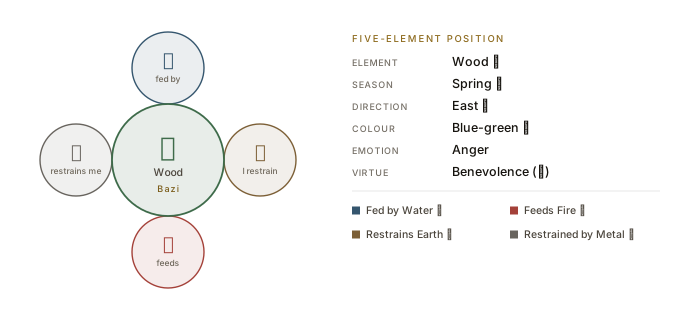
At a glance
Wood appears in a chart as the stems 甲 and 乙 and the branches 寅 and 卯 — the four characters everything else is derived from.
In the classical correspondence tables Wood governs spring and the east, the liver and gallbladder, the eyes, and the sour taste.
How Wood appears in a chart
The two stems are not the same phase twice. 甲 is yang Wood: the tree, the beam, the thing that grows straight and is used for structure. 乙 is yin Wood: the vine, the grass, the thing that grows by going around obstacles. The classical contrast is between being straight and being adaptable, and a chart with 甲 in a position of authority reads very differently from one with 乙 in the same place.
The branches carry the season. 寅 is the first month of spring, yang, and contains hidden stems that make it more than pure Wood; 卯 is the second month, yin, and is the purest Wood in the system. A Wood stem sitting on 卯 is rooted in the strongest possible ground; the same stem sitting on 酉 — the Metal branch directly opposite — is rootless and being cut, which is the classical picture of Wood that looks present and cannot hold.
As a day master, Wood is read as the self. A 甲 day master is described as principled, direct, and slow to change course; a 乙 day master as flexible, persistent, and harder to pin down. Neither is a personality verdict — the day master is one character in a chart of eight, and the other seven decide how much of it can act.
Stems, branches, and the day master
The stems
甲 yang Wood: straight growth, structure, the beam. 乙 yin Wood: flexible growth, persistence by other means, the vine. The pair is the clearest example in the system of why yin and yang are not strong and weak.
The branches
寅 the first spring month, yang, mixed. 卯 the second spring month, yin, pure Wood. Rooting in either makes a Wood stem strong; the opposite branches 申 and 酉 make it weak.
As a day master
Read as the self, not as a trait. A 甲 day master wants to go straight; a 乙 day master wants to arrive. What the chart supports decides whether either gets to.
The Wood characters
甲 Jiǎ (yang), 乙 Yǐ (yin)
寅 Yín (tiger), 卯 Mǎo (rabbit)
3 and 8
角 jué
How much weight this carries
This is the most technical page in the set and the most falsifiable: either a chart contains Wood characters or it does not. What is not falsifiable is what those characters mean — that part depends on the practitioner, the school, and the question being asked.
Related Concepts
Common questions
How do I know if I am a Wood day master?
By the stem of your day pillar, which requires converting the birth date to the solar calendar and finding the day's stem. The free calculator on this site does that conversion.
Is 甲 Wood better than 乙 Wood?
No, and the question is a category error. 甲 is strong in structure and brittle in change; 乙 is the reverse. Which is 'better' depends entirely on what the rest of the chart needs.
What does it mean to have no Wood in a chart?
That the phase is supplied by the luck cycles rather than by the birth chart. It is common and not a defect — a chart is read for balance, not for completeness.
Explore more
Want this applied to your own chart?
The database explains the symbol. A reading connects it to your birth data — BaZi, Zi Wei, element balance, and the symbols that keep recurring.
See personalized readings →