Ten-Year Luck Pillars, Explained
How the luck pillars are derived, what they do and do not predict, and why the same year treats two charts differently.
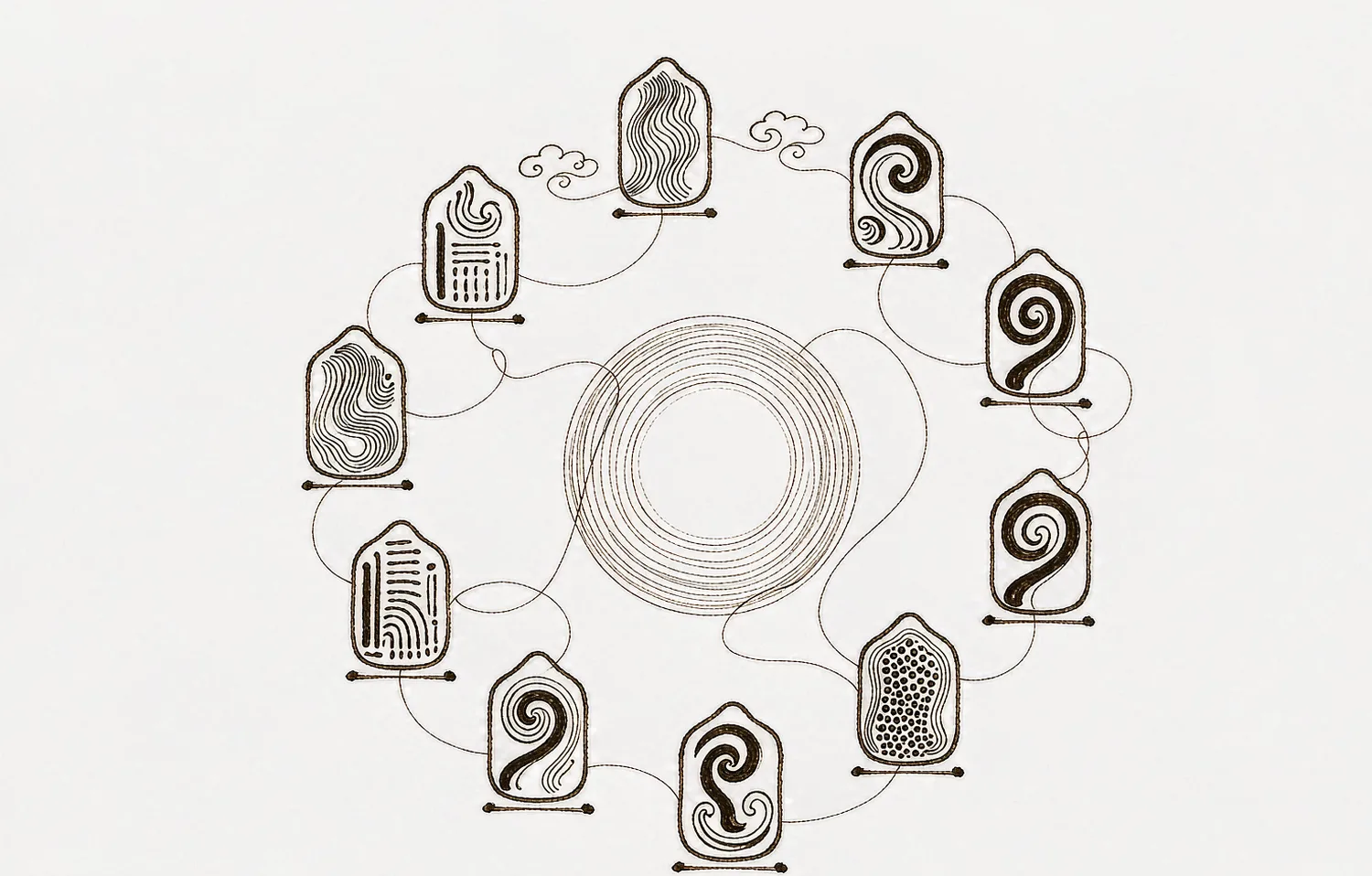
The luck pillars (大运, da yun) are the ten-year periods that run through a Chinese birth chart. They are the closest thing BaZi has to a timeline, and they are the reason practitioners say a chart is not a fixed description: the same birth chart produces a different life depending on which luck pillars it passes through.
They are also the most misunderstood part of the system, because they are frequently described as if they were a schedule of events.
How they are derived
The luck pillars are built from the month pillar, advancing through the sixty stem-branch cycle. Starting from the month pillar, the first luck pillar is the next pair in the sequence, and each subsequent pillar follows on, so a life is described by a chain of ten-year periods each carrying a stem and a branch.
Whether the sequence runs forward or backward depends on the polarity of the birth year stem and the person's sex, which is why two people born in the same year can run their cycles in opposite directions. The starting age depends on the distance between the birth date and the nearest solar-term boundary.
What they do
A luck pillar changes the environment around a chart. If your day master needs Water and the decade brings a Water stem and branch, the decade is described as supportive. If it brings heavy Fire, the decade is described as demanding, and the chart's own resources become the variable that decides the outcome.
This is the key point and it is often lost: a luck pillar does not produce events. It changes what the chart is working with. Two identical charts with different internal balance will experience the same luck pillar differently, which is why honest practitioners resist giving event-level forecasts.
The interplay with annual pillars
Inside each ten-year luck pillar run the annual pillars — the stem-branch pair of each calendar year. Practitioners read the annual pillar against both the birth chart and the current luck pillar, so there are three layers active at once.
This is where the popular zodiac forecasts come from, in a simplified form: comparing the year branch to the birth year branch produces the Tai Sui readings — clashing, combining, offending. Those readings use one position out of eight, which is why they are coarse, and why the same year treats two people with the same sign very differently once the rest of the chart is included.
What they cannot do
The luck pillars cannot tell you what will happen. They describe which forces are in play and whether they support or strain the chart. The tradition itself is divided on how far this extends — classical texts describe tendencies and timing of pressure, not specific outcomes.
Used well, a luck pillar reading is a description of conditions: this decade supports expansion, this one requires consolidation, this one puts pressure on the same fault line as the last one. Used badly it becomes a fortune-telling service, and the failure rate of the second use is well documented by anybody who has tried it.