The Body Palace: The One Square a Zi Wei Chart Never Gives You
Twelve squares, twelve names — and one has to hold two. The Body Palace has no square of its own; which square it borrows is decided by birth hour alone.
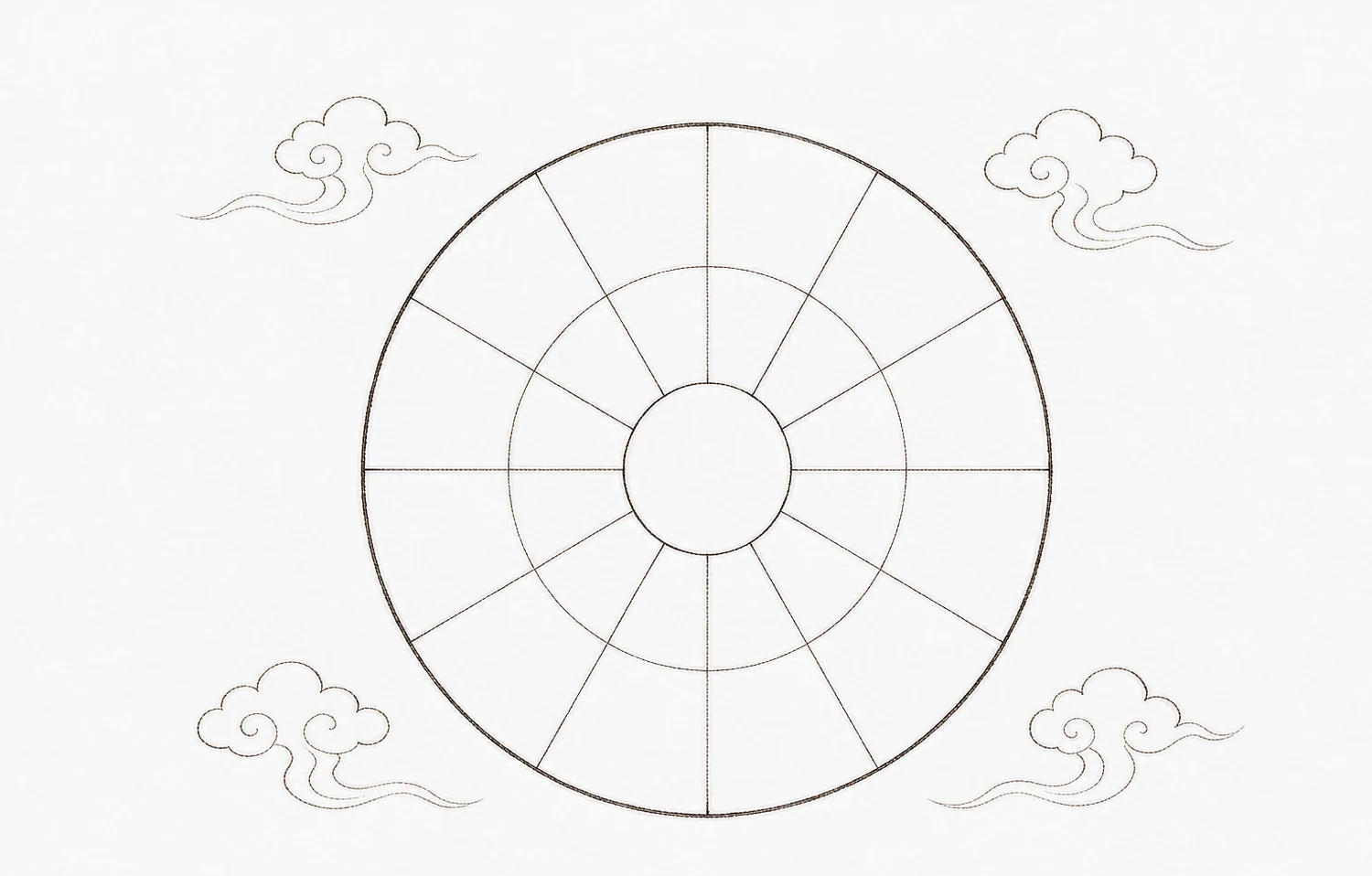
A Zi Wei chart is drawn as a grid of twelve squares, and every square carries a name: Life, Siblings, Spouse, and so on. Then a chart is cast and one of those names turns up twice — the Body Palace is announced as sitting 'in' the Life Palace, or in Travel, or in Career.
It looks like a labelling quirk. It is not. The Body Palace has no square of its own by design, and the way it borrows one is the clearest example in the whole system of how position and function are separated. Once you see the rule, the six squares it can land on stop looking arbitrary — they are three opposite pairs, and they are the only three pairs it could be.
Twelve squares, eleven tenants
Start with what the chart physically is. Twelve palaces are placed around the grid by counting from the Life Palace, which is itself fixed by the birth month and the birth hour. The stars are then distributed into those squares. All of that machinery produces twelve named positions and no spare room.
The Body Palace is the thirteenth thing that needs a location, so it is placed on top of one of the twelve rather than beside them. The traditional phrasing is that the Body Palace 寄 (lodges) in a palace. Nothing is missing from the chart; something is doubled up.
The hour decides, and nothing else does
The rule is short: count forward from the birth month to the birth hour to get the Body Palace, where the Life Palace counts backward from the same starting point. Same two inputs, opposite directions, which is why the two palaces are usually described as mirror images of each other.
Here is the part worth checking rather than taking on trust. Run the calculation across twelve different dates and every hour of the day, and the birth month never changes the answer. Each hour lands the Body Palace in one fixed square every time. The month sets where the counting starts; the hour alone decides where it stops, because the Life Palace already absorbed the month when it was placed first.
That has a practical consequence: you can name your Body Palace from your birth hour without knowing anything else about your chart. Born in the hour of the Rat or the Horse, it sits on Life. Ox or Goat puts it on Fortune. Tiger or Monkey, Career. Rabbit or Rooster, Travel. Dragon or Dog, Wealth. Snake or Pig, Spouse.
Why those six, and not the other six
Six of the twelve squares can hold the Body Palace and six cannot, and the split is not arbitrary either. Read the two rows in the figure: Life sits opposite Travel, Spouse opposite Career, Wealth opposite Fortune. Those are the three pairs the Body Palace can occupy, and every other pair — Siblings and Friends, Children and Property, Health and Parents — it can never touch.
The reason is arithmetic rather than tradition. Moving the birth hour by one shifts the Body Palace two squares away from the Life Palace, and two at a time through twelve positions can only ever reach 0, 2, 4, 6, 8 and 10. Those six offsets are exactly the three opposite pairs. No ruling had to be handed down for this; it falls out of the counting.
What it adds: the layer that acts
The usual division of labour is that the Life Palace describes what someone is and the Body Palace describes what they do with it. Life is the disposition; Body is the behaviour — the part that shows up in how a person actually spends their time, where they move, and which of their traits gets exercised.
The reading that follows is comparative, which is why the doubled square is useful rather than inconvenient. When the Body Palace lands on Life, disposition and behaviour agree, and the classical comment is that the person is consistent — sometimes to the point of being predictable. When it lands on the opposite square, the classical comment flips: what the chart says about them and what they actually do pull in different directions. Neither is better. They are two different relationships between intent and action, and both are readable.
There is also an older convention that the Body Palace carries more weight later in life and the Life Palace more weight early on. Treat that as a convention rather than a finding: it is a reading habit that practitioners pass down, not something the placement itself demonstrates.
Where the method stops being precise
Two things deserve to be said plainly. First, the Body Palace does not carry its own star set: the stars in that square are the stars of whichever palace it lodged in, and the reading is about the relationship between the two layers, not about a third set of placements.
Second, there is genuine disagreement about how much the Body Palace should carry. One school gives it a life-stage reading and pairs it with the decade cycles; another treats it as a secondary note that should never override the Life Palace. Both positions are argued from the same classical texts, and a chart read by two practitioners can legitimately come back with different weights on it. What is not in dispute is the placement rule itself — that part is arithmetic, and the calculator on this site computes it the same way every time.