Property Palace (田宅宫)
The Property Palace (田宅宫) begins with houses and land, and extends to everything that stores value and holds stability: home, savings, the household as an institution, and the physical base your life operates from.
Home, assets and the ground under your feet
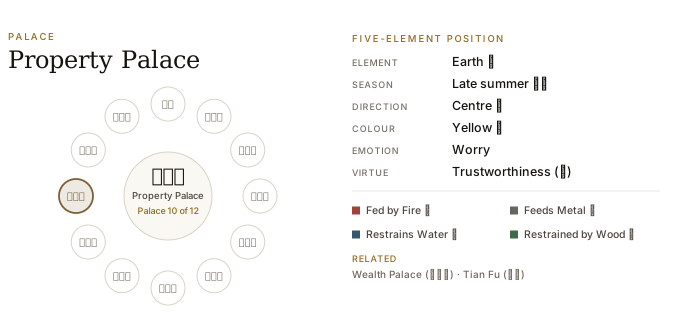
At a glance
The palace of what is held — property, household, and the physical base.
The classical reading asks whether property is acquired, kept, or lost, and treats the household as the unit rather than the individual. Tian Fu is the star most cited here, and its reading is about stewardship.
What this palace governs
Whether your living situations tend to be havens or hassles — and how you settle into a place.
Property, deposits, equity, collectibles — the assets your life naturally accumulates.
The family-as-institution: whether the home front is a platform or a battlefield.
Your need for a physical base, and what happens to you when you lack one.
The fourteen major stars in this palace
A well-kept home that functions as a base and often as a place others gather. Property tends to be substantial and held long.
Property changes hands repeatedly. You are good at identifying a sound asset and poor at holding one through the boring middle of the holding period.
A bright, well-situated home that often becomes a gathering place. Property tends towards quality and, traditionally, southern aspect.
Strong placement for property — you accumulate real assets and hold them. Multiple properties over a lifetime is characteristic.
A comfortable home that matters emotionally more than financially. Property arrives reasonably and is held for comfort rather than appreciation.
Property changes hands and is occasionally the subject of dispute. Contracts deserve more care than usual for this placement.
The strongest property placement in the system, and the classical indicator of family holdings. Land and buildings accumulate across this placement's lifetime.
The strongest of the classical property stars, together with Tian Fu. Land and buildings accumulate across the lifetime of this placement, often quietly.
Property moves through your hands repeatedly. You are good at spotting opportunity and less good at holding assets across a slow cycle.
Property is read as a source of dispute for this placement — co-ownership, inheritance or contractual matters. Documentation matters more than usual.
Property is orderly, well-presented and secure, with a tendency towards quality over quantity. Documents and titles tend to be handled properly.
Property is secure, frequently assisted by family or senior figures, and held for a long time. Houses with this placement in the Property palace tend to be homes rather than assets.
Property is acquired decisively and can be sold with equal speed. Leverage is this placement's characteristic temptation in this area.
The most changeable property placement in the system — acquired, sold, relocated and rebuilt repeatedly. Land is a poor holding for this chart; mobility is the actual asset.
How it is read
Classical readers used this palace for landholding, which was wealth in agrarian terms. Modern readings treat it as asset temperament: some structures stack property, some hold cash, some hold nothing but always land somewhere soft.
The palace is read against the Wealth Palace: Wealth is flow, Property is storage. Strong flow with weak storage is the high-earner with no savings; the reverse is the quiet accumulator.
A dim palace here does not predict losing a home. It predicts that home and assets require deliberate structure — budgets, contracts, maintenance — rather than running on autopilot.
Related Concepts
Common questions
Does this palace predict whether I will own a house?
It describes your asset tendencies, not the market or your city's prices. The pattern tells you how you store value — the actual purchase depends on era and decisions.
What does Tian Fu here mean?
The treasurer's signature: a natural instinct to hold, build and consolidate. Home as fortress, assets as rails.
Is this palace relevant if I never buy property?
Yes — it governs whatever stores your stability: savings, the quality of your rentals, the household you run. Everyone has a home front.
My Property Palace is strong but Wealth is weak — what does that mean?
The classic slow-builder: keeps well, earns unevenly. The practical reading is to design income around the weak point instead of assuming the assets will grow themselves.
Explore more
Want this applied to your own chart?
The database explains the symbol. A reading connects it to your birth data — BaZi, Zi Wei, element balance, and the symbols that keep recurring.
See personalized readings →