Po Jun (破军)
Po Jun is the system's agent of change: the star that takes apart what exists so that something else can be built. Where it falls, life is eventful, reinvented repeatedly, and never settled for long.
The Pioneer
At a glance
The star of breaking — dismantling what exists so something else can be built.
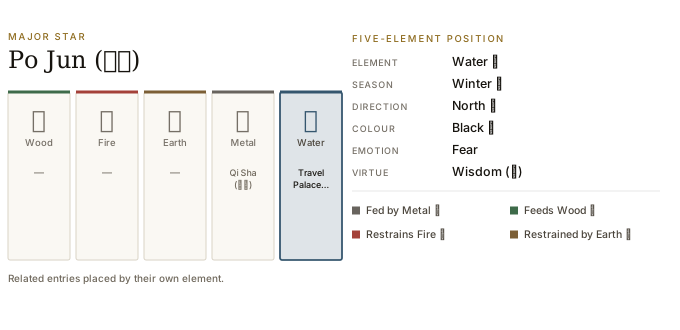
Assigned to 癸水 (yin water), Po Jun is described as water that breaks a dam. The classical reading treats it as the most destabilising of the fourteen and, in the same texts, as the necessary one — nothing in the system is rebuilt without it.
What Po Jun means
破军 is the耗星 — the star of expenditure and disruption — and it is the last of the fourteen, which is thematically correct: it is the star that ends things. Its nature is to break structures that have run their course, and it does so whether or not a replacement has been arranged.
Charts with Po Jun prominent are the least conventional in the system. They change careers, cities, industries and identities, frequently more than once, and they are genuinely good at the beginnings that follow destruction: turnarounds, startups, rebuilds, reforms. The system associates this star with pioneers, soldiers, reformers and the particular kind of person who is at their best in a situation everyone else has abandoned.
The classical warning is about the cost of the tearing-down. Po Jun does not preserve, so things that were working get dismantled along with things that were not, and charts with this star often describe a life of significant losses between the wins. The traditional remedy is a purpose: the star is tolerable in a person with a mission to spend itself on, and destructive in a person without one.
From the inside
You have probably noticed that stability bores you to the point of physical discomfort, and that you have explained this to people as needing a challenge — which is accurate and also an oversimplification. The honest version is that keeping something going interests you far less than making it work at all, and you will sometimes end a good situation because it stopped being a project. The useful discipline for this star is not patience; it is finishing, and choosing some things to keep rather than rebuild.
Where Po Jun is strong
You can rebuild a life or an organisation from a standing start, repeatedly. Very few people can do this once.
You will end what is not working when everyone else is still protecting it. In a declining situation, this is the only useful function available.
You work with what is at hand and improvise under constraints that stop more orderly people.
You lose a great deal across a lifetime and keep going, which is why this chart so often ends up ahead of where it started.
Where it goes wrong
Your instinct to overhaul does not distinguish between a failing structure and a functioning one that has become familiar.
You can organise a life around constant change so thoroughly that nothing compounds — no career capital, no long relationship, no accumulated position.
The people, assets and reputations around the change do not always get consulted, and the cost is borne by whoever was standing nearby.
Perpetual reinvention is expensive. Charts with this star strong tend to run themselves down and describe it as normal.
At its best
A strong Po Jun is one of the great pioneering configurations — the person who founds, reforms and rebuilds, often in unfashionable places. Dimmed or unsupported, the same star reads as instability: changes with no destination, and a life spent paying for transitions.
Pairings and combinations
With Wu Qu it becomes a powerful entrepreneurial pairing — appetite for change with real execution behind it. With Zi Wei the disruption acquires authority. With Tian Fu the chart finally has something that holds on to assets, which is the standard prescription for this star. With Lian Zhen it becomes considerably more intense and complicated.
In the twelve palaces
Unconventional, eventful and repeatedly rebuilt. The life is rich in experience and short on continuity, and the work is choosing what to keep rather than what to change.
Startups, turnarounds, restructuring, reform, construction and demolition, crisis management, frontier markets, anything requiring someone to build where nothing exists. Poorly suited to stable institutional tenure.
A small number of children or a relationship marked by change and distance. What children need from this placement is constancy, which is the one thing it must supply deliberately.
Restless inner life requiring a mission to spend itself on. Contentment for this placement is nearly impossible in the absence of a project and surprisingly easy in its presence.
A rotating network with a few very old connections. You are loyal in depth and light in maintenance, and the friends who survive the changes are genuinely permanent.
Depletion and the kidneys in the traditional mapping, with injury and exhaustion as the characteristic patterns. This placement does not get warning signs that it respects.
An upbringing marked by change, sometimes by family disruption, and an early departure from home. What you took from it is the assumption that you can start again.
The most changeable property placement in the system — acquired, sold, relocated and rebuilt repeatedly. Land is a poor holding for this chart; mobility is the actual asset.
Relations with siblings are distant or interrupted, often by distance in geography rather than by conflict. You are usually the one who left.
The classical advice for this placement is a late marriage, and the reading is about change rather than about hostility. The version that works pairs you with someone who is not destabilised by reinvention.
The travel palace placement for this star is a strong argument for living away from where you started. Movement and reinvention in a new place produce far better outcomes than the same effort at home.
Money arrives in large movements and leaves the same way — big wins, large losses and a lifetime balance that depends entirely on retention policy. The star spends by nature; the fix is automatic and boring.
Related Concepts
Common questions
What does Po Jun in the Life palace mean?
A life of change, reinvention and unusual paths. Po Jun in the Life palace is traditionally read as one of the more difficult placements and one of the better ones for pioneering work — the star takes apart as readily as it builds.
Is Po Jun a bad star?
It is a disruption star, which is a category the classical texts treat with caution rather than condemnation. In a supported chart it produces the people who found and rebuild; in an unsupported one it produces instability and loss. The star itself is neither.
What does Po Jun need?
Something to hold — traditionally Tian Fu or Wu Qu, which supply retention and execution. And a purpose: this star will spend itself on something, and the only question is whether the thing it spends itself on was chosen.
Why is Po Jun advised against early marriage?
Because the placement is associated with change and upheaval, and the classical advice is simply to marry after the person has settled into a version of themselves they intend to keep. Charts with this star frequently describe an early relationship that did not survive a reinvention.
Explore more
Want this applied to your own chart?
The database explains the symbol. A reading connects it to your birth data — BaZi, Zi Wei, element balance, and the symbols that keep recurring.
See personalized readings →