Fire in Feng Shui
In a room Fire is light and the place where people gather. Almost everything sold as 'the fire element' — candles, red cushions, a fireplace video on a screen — is either decoration or a different phase, and the tradition's own version is much closer to lighting design than to ornament.
火 Huǒ · summer · south
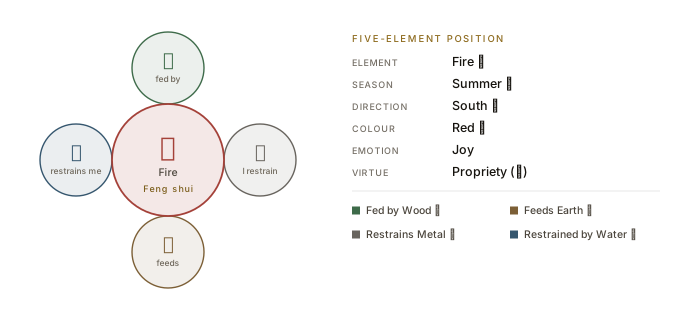
At a glance
In a room Fire is light and the gathering place — closer to lighting design than to red cushions.
In the classical correspondence tables Fire governs summer and the south, the heart and small intestine, the tongue, and the bitter taste.
Fire in a room
The working distinction is between light that reveals and heat that changes. A south-facing window is Fire; a lamp over a table where people talk is Fire; a heater is not, in the classical reading, because it changes temperature rather than making anything visible. This is why the tradition's Fire corrections are usually about arrangement and light rather than about buying an object.
Room by room the logic holds: the gathering space gets the light, the sleeping space gets none of it, and the workspace gets enough to see by without the glare that produces fatigue. Fire placed in a room used for rest is the single most common error in domestic feng shui, and it is the one with the most obvious practical consequence.
Corrections are mostly subtractive again. Reduce the brightest light in the bedroom, remove the red accent from the room that needs calm, and stop treating a screen as a hearth. Then one deliberate source of warm light where people actually sit together — which is the part that requires a decision about how the room is used rather than a purchase.
Room by room
Room by room
Living and gathering space: the strongest light, and seating arranged so people face each other rather than a screen. Bedroom: no Fire — dim, warm, and low. Workspace: enough light to see, not enough to glare.
Corrections
Take the red out of the bedroom; stop using a screen as a substitute for a hearth; and if the chart is already hot, add shade and quiet rather than more light.
Objects and placements
south
red
pointed and tapering
Mars
How much weight this carries
Feng shui claims are the hardest to test and the easiest to sell, which is exactly why this page stays descriptive. The classical correspondences (south, red) are consistent across schools; the claims about outcomes are not, and no arrangement here substitutes for a working lock, a smoke alarm, or daylight.
Related Concepts
Common questions
Do candles count as the fire element?
Literally, yes — they produce light and heat from combustion. The tradition's caution is about placement rather than about the object: a candle in a bedroom is Fire where Fire should not be.
Is a fireplace good feng shui?
For a gathering room, traditionally yes, because it is the classical hearth. In a chart that is already hot, the reading is less enthusiastic.
Should I use red in the south?
Only if the chart needs Fire. The south is already the Fire direction, and adding the Fire colour there is doubling a dose rather than balancing one.
Explore more
Want this applied to your own chart?
The database explains the symbol. A reading connects it to your birth data — BaZi, Zi Wei, element balance, and the symbols that keep recurring.
See personalized readings →