Fire and Food
The taste the tradition assigns to Fire is bitter, and it is the one assignment that reads as medicine rather than as preference. Bitter cools, dries, and moves things downward — the exact opposite of what the phase does when it is excessive.
火 Huǒ · summer · south
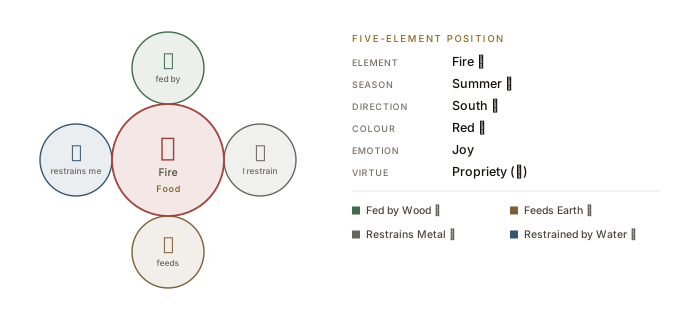
At a glance
Fire's taste is bitter — the one assignment that reads as medicine, because bitter does the opposite of what Fire does.
In the classical correspondence tables Fire governs summer and the south, the heart and small intestine, the tongue, and the bitter taste.
The taste the tradition gives Fire
That opposition is why the assignment works. Fire rises and disperses; bitter descends and settles. In a chart that is hot the tradition adds bitter greens, bitter melon, dark chocolate in the older medicinal sense, and the roasted, charred flavours that sit at the edge of edible — all of them things that pull the system back down.
The grain assigned to Fire is millet, which is a small, dry, warming grain rather than a cooling one — a reminder that the correspondence tables are not internally consistent about temperature. The taste and the grain answer different questions: what the phase needs, and what the phase is made of.
What drains Fire in this scheme is cold and raw food in quantity, which is read as Water suppressing the phase, and stimulants, which are read as borrowing Fire rather than making it. The practical translation is the one piece of five-element dietary advice that survives scrutiny: if a person is running hot and sleeping badly, the first thing to remove is the thing they are using to keep going.
What feeds it, what drains it
What feeds it
Warm, cooked, aromatic food, and millet as the assigned grain. The pattern is heat and stimulation in moderation rather than any particular ingredient.
What drains it
Cold and raw food in quantity, and stimulants used as a substitute for rest. The tradition reads the second as borrowing, which is why the debt always arrives.
The Fire table
bitter
millet
heat
heart
How much weight this carries
Dietary correspondences are the place where five-element thinking is most often confused with nutrition. Fire foods are not automatically good for heart in any medical sense. What the tradition actually does is assign a taste and a temperature to foods and ask whether the chart needs more or less of that quality.
Related Concepts
Common questions
Are bitter foods good for the heart?
In this system bitter is assigned to Fire, which governs the heart, but the assignment describes a direction of effect — cooling — not a cardiac benefit.
Why is millet the Fire grain?
Because the five grains are assigned by season and quality, and millet is the small dry grain of the hot months. The reasoning is agricultural, not nutritional.
Should a Fire-heavy person avoid spicy food?
The tradition would say reduce heat generally, which includes spice. It is a weaker claim than it sounds, and it is consistent with how most people feel after a very hot meal.
Explore more
Want this applied to your own chart?
The database explains the symbol. A reading connects it to your birth data — BaZi, Zi Wei, element balance, and the symbols that keep recurring.
See personalized readings →