Fire and Health
In the classical body map Fire governs the heart and the small intestine, opens into the tongue, controls the blood vessels, and is disturbed by joy in excess. The last item is the one that surprises people: in this system even a good emotion becomes a problem when it does not stop.
火 Huǒ · summer · south
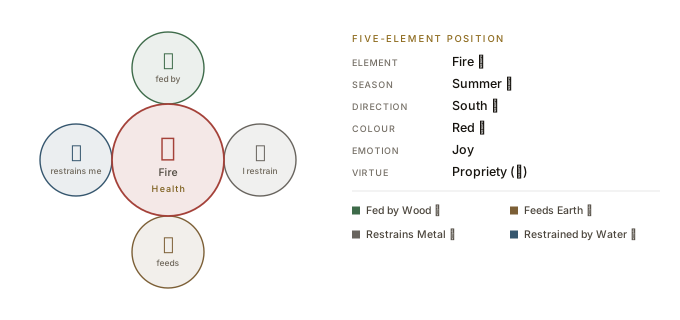
At a glance
In the classical body map Fire governs the heart and small intestine, the tongue, the blood vessels, and the emotion of joy.
In the classical correspondence tables Fire governs summer and the south, the heart and small intestine, the tongue, and the bitter taste.
The body map the tradition assigns to Fire
The heart's role here is not the modern one. It is the seat of spirit — 神 — the thing that makes a person present and coherent, and the classical signs of heart disturbance are as much about sleep, restlessness and clarity as about the organ itself. A person whose chart is Fire-heavy and unsettled is described as scattered rather than ill.
The tongue and the vessels follow the same logic of visibility: Fire is the phase that shows, so the tissues it governs are the ones that display state. Complexion, pulse, speech — a practitioner reads Fire conditions by looking and listening, which is why the correspondence is one of the oldest in the system.
The bitter taste assigned to Fire is the traditional corrective: cooling, drying, and slightly unpleasant, which is exactly what an overheated chart is said to need. This is the most intuitive of the five taste assignments, and the one most likely to be taken too literally — bitter greens are not a treatment for anything.
Signs of imbalance
Signs of imbalance
Sleep that will not settle; a mind that runs at night; flushing and heat in the chest or face; palpitations described as fluttering; speech that accelerates; and in the classical picture, a tongue that is red or overly pale.
What the tradition recommends
Cooling and quiet: bitter in moderation, less stimulation in the evening, and rest that is actually restful rather than merely motionless. The advice is unremarkable and it is the same advice a doctor gives about sleep.
Fire in the body
heart
small intestine
tongue
blood vessels and pulse
joy
bitter
How much weight this carries
This is the weakest claim on the site, and it should be stated plainly. The correspondences (heart, small intestine, tongue, bitter) are a classical map of relationships between categories, not a description of organs. They were built to organise symptoms, not to diagnose them. Anyone with an actual symptom should see a doctor, and no page here should delay that.
Related Concepts
Common questions
Does a Fire chart mean heart problems?
No. The correspondence organises a category of signs; it does not predict disease. Palpitations in particular should be investigated medically and not read as an element imbalance.
Why is joy assigned to the heart?
Because joy is the emotion of expansion and the heart is read as the centre of spirit. The classical warning is about excess — joy that cannot settle scatters the spirit.
What does a red tongue mean in this system?
Heat, traditionally, and often Fire. It is one observation among several and is not diagnostic on its own.
Explore more
Want this applied to your own chart?
The database explains the symbol. A reading connects it to your birth data — BaZi, Zi Wei, element balance, and the symbols that keep recurring.
See personalized readings →