Water and Food
The taste the tradition assigns to Water is salty, and the assignment is about softening and descending rather than about seasoning. 鹹 is the quality that moves things downward and inward — salt, seaweed, and the preserved foods of a winter diet.
水 Shuǐ · winter · north
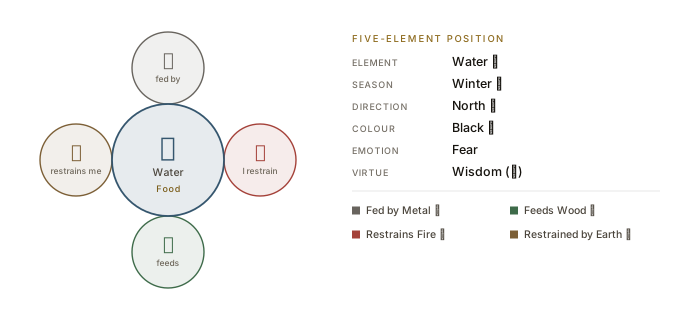
At a glance
Water's taste is salty — the quality that descends and softens, assigned to the phase of the deepest layer.
In the classical correspondence tables Water governs winter and the north, the kidney and bladder, the ears, and the salty taste.
The taste the tradition gives Water
That function is why the taste belongs to the phase of storage. Water governs the deepest layer, and salt is read as reaching it — which is why a small amount is described as softening and moistening, and too much is described as damaging the bones and the blood. The classical warning is specific: excess salt is said to harm the very tissue Water governs.
The grain assigned to Water is beans, which are the storage form of a plant — the seed kept through winter rather than the leaf eaten in spring. The correspondence is consistent with the phase in a way that several of the other grain assignments are not.
What drains Water in this scheme is cold and raw food in quantity, excessive fluid taken in a way that does not warm, and stimulants, which are read as drawing on the reserve rather than adding to it. The practical translation is the one that survives scrutiny: if a person is depleted, cold and anxious, the first thing to add is warmth and the first thing to remove is the thing they are using to keep going.
What feeds it, what drains it
What feeds it
Beans, seaweed, and the preserved and salted foods of a winter diet, in moderation. The pattern is storage and depth rather than stimulation.
What drains it
Cold and raw food in quantity, excess fluid that does not warm, and stimulants used as a substitute for rest. All three are read as drawing on the reserve.
The Water table
salty
beans
cold
kidney
How much weight this carries
Dietary correspondences are the place where five-element thinking is most often confused with nutrition. Water foods are not automatically good for kidney in any medical sense. What the tradition actually does is assign a taste and a temperature to foods and ask whether the chart needs more or less of that quality.
Related Concepts
Common questions
Is salt good for the kidneys?
In this system salty is assigned to Water, which governs the kidney, and the classical position is that a little softens and a lot damages. Modern medicine is considerably less romantic about salt.
Why is beans the Water grain?
Because beans are the storage form of the plant — the seed kept through winter. The reasoning is seasonal, not nutritional.
Should a Water-heavy person avoid salt?
The tradition would say reduce the taste that matches the excess, which is the general rule for all five. It is a modest claim.
Explore more
Want this applied to your own chart?
The database explains the symbol. A reading connects it to your birth data — BaZi, Zi Wei, element balance, and the symbols that keep recurring.
See personalized readings →