Water and Health
In the classical body map Water governs the kidney and the bladder, opens into the ears, controls the bones and marrow, and is disturbed by fear. It is the phase of reserves — the deepest and slowest layer, and the one the tradition treats as the foundation of the others.
水 Shuǐ · winter · north
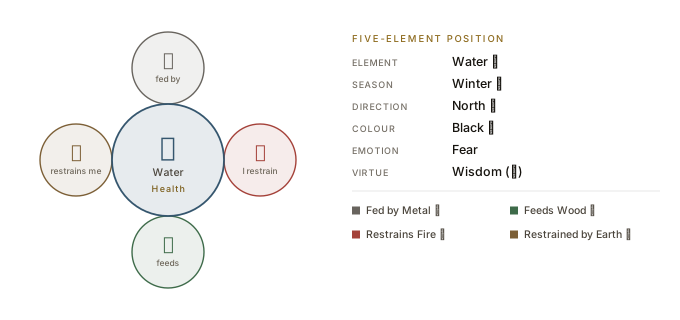
At a glance
In the classical body map Water governs the kidney and bladder, the ears, the bones and marrow, and the emotion of fear.
In the classical correspondence tables Water governs winter and the north, the kidney and bladder, the ears, and the salty taste.
The body map the tradition assigns to Water
The kidney's role here is not filtration alone. It is the store of essential qi — the reserve a person draws on over a lifetime — which is why the classical signs of kidney deficiency are about depletion rather than about an organ: lower-back ache, weak knees, poor memory, tinnitus, and a tiredness that sleep does not fix.
The bones and marrow follow the same logic of depth. Water is what the body is built from at the level that does not renew quickly, so the tissues it governs are the structural ones and the classical signs of decline in old age are read as Water depleting. The ear correspondence is the same idea at the surface: hearing is read as a function of reserve.
The cold correspondence is the most practical item. Water governs cold, winter is its season, and the traditional response to a cold-deficient picture is warming — cooked food, covering the lower back, and rest that is longer than usual. The tradition's insistence that winter is for storage rather than for effort is the phase's own principle applied to the year.
Signs of imbalance
Signs of imbalance
Lower-back ache and weak knees; tinnitus; poor memory; a cold feeling that will not shift; frequent urination at night; and a tiredness that rest does not resolve.
What the tradition recommends
Warmth and rest: cooked food, covering the lower back, longer sleep in winter, and less expenditure of every kind. The classical instruction is to store rather than to spend.
Water in the body
kidney
bladder
ears
bones and marrow
fear
salty
How much weight this carries
This is the weakest claim on the site, and it should be stated plainly. The correspondences (kidney, bladder, ears, salty) are a classical map of relationships between categories, not a description of organs. They were built to organise symptoms, not to diagnose them. Anyone with an actual symptom should see a doctor, and no page here should delay that.
Related Concepts
Common questions
Does a Water chart mean kidney problems?
No. The correspondence groups signs around reserves and depletion; it does not predict disease. Persistent symptoms need a doctor.
Why is fear assigned to the kidney?
Because fear is what depletion feels like when it reaches the deepest layer. The tradition reads chronic fear as a drain on the reserve rather than as a mood.
Why is the lower back associated with Water?
Because the kidney is read as the seat of essential qi, and the lower back is where the classical texts locate it. The association is anatomical in the traditional rather than the modern sense.
Explore more
Want this applied to your own chart?
The database explains the symbol. A reading connects it to your birth data — BaZi, Zi Wei, element balance, and the symbols that keep recurring.
See personalized readings →