Wood Colours
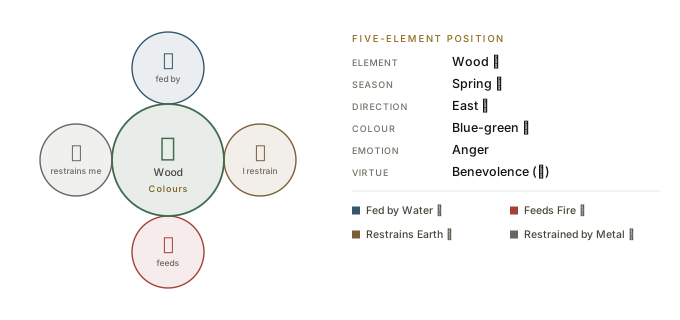
Wood's colour is 青, a blue-green that sits between the two names English gives it. It is the colour of a young shoot rather than a mature canopy, which is why the same character also means 'young' in classical usage — spring green, not forest green.
木 Mù · spring · east
At a glance
Wood's colour is 青 — the blue-green of new growth, closer to a young shoot than to a mature canopy.
In the classical correspondence tables Wood governs spring and the east, the liver and gallbladder, the eyes, and the sour taste.
Why Wood is blue-green
The distinction matters in practice. A Wood-dominant chart that is short of Water tends toward the pale, yellowish end of the range — growth without enough supply — while one with strong Water behind it runs to a deeper, bluer green. Practitioners who use colour as a diagnostic read the shade, not the category, and the shade is determined by what is feeding the phase.
As an applied correspondence, 青 is used in clothing, in the east side of a room, and in the small objects a person handles daily rather than in large decorative gestures. The tradition's logic is cumulative and modest: a colour repeated in ordinary places is supposed to act like a reminder, and a reminder only works if it is not a statement.
Where it goes wrong is when the colour becomes decoration instead of signal. A green wall in a house whose occupant has an overgrown Wood chart is not neutral — it is the correspondence applied in the wrong direction. The same logic explains the classical preference for restraint in all five colours: they are doses, and the system assumes you know which way you are dosing.
How the colour is used
How the colour is used
Small and repeated: a notebook, a mug, a scarf, the east end of a desk. The point is frequency of encounter rather than area covered.
Where it goes wrong
Applied to an already-excessive Wood chart, or used as the dominant colour of a room. Both turn a reminder into a repetition of the problem the chart already has.
The Wood palette
blue-green
青
east
spring
How much weight this carries
Colour correspondences are the most usable part of the system and the least metaphysical: they are a convention, and conventions work by being shared. Wearing blue-green does nothing on its own. It does something when the person wearing it is paying attention to what it is for.
Related Concepts
Common questions
Is green good luck in Chinese culture?
Not in the simple sense. 青 is the colour of spring and growth, which is auspicious in a starting context and inauspicious in a context that needs restraint. The five-element reading is always relative.
What is the difference between 青 and 绿?
綠 is the ordinary word for green; 青 covers the blue-green range and carries the classical correspondence. Wood's colour is the second, which is why jade and celadon sit inside it and grass green does not.
Should I paint a room green for Wood?
Only if the chart is short of Wood and the room is not already the busiest, most growth-oriented space in the house. Otherwise the correspondence is being applied against its own logic.
Explore more
Want this applied to your own chart?
The database explains the symbol. A reading connects it to your birth data — BaZi, Zi Wei, element balance, and the symbols that keep recurring.
See personalized readings →