Wood and Direction
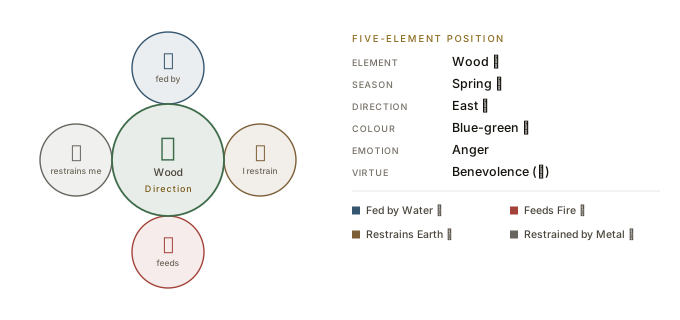
Wood sits east, the direction the sun comes from. The correspondence is the least arbitrary in the whole system: east is where light starts, spring is when the year starts, and Wood is the phase of starting, so all three line up without any further argument.
木 Mù · spring · east
At a glance
Wood sits east — the direction of the rising sun, and the placement follows from that image.
In the classical correspondence tables Wood governs spring and the east, the liver and gallbladder, the eyes, and the sour taste.
Why Wood sits east
In a room the traditional placement puts living growth on the east side and, more importantly, puts the place a person faces in the morning toward it. The reasoning is not mystical — morning light on the east side of a building is real, and the correspondence is a memory aid for a piece of practical advice about daylight and orientation.
The distinction the tradition insists on is living wood versus cut wood. Plants, growing things, and anything with a direction of growth are Wood. Furniture is not: a wooden table is a finished object, and in five-element terms it belongs to the wealth-and-structure reading rather than to growth. This is why 'add wood to the east' does not mean 'buy a bookshelf'.
What not to do is more specific than the positive advice. Dead plants, dried arrangements, and the plastic version of a living thing are all read as Wood that has stopped — the phase present in form and absent in function. In a room where someone is trying to start something, the tradition considers that worse than an empty corner.
Placement, and what not to do
Placement
Living plants on the east side; a desk or chair oriented so the person faces east in the morning; the tallest growing thing in the room placed where it does not block the light it is there to represent.
What not to do
Dried or artificial plants in the east, and a wall of furniture treated as 'wood'. Neither carries the phase; both make the correspondence look like superstition when it is really just a category error.
The Wood compass
east
東
blue-green
spring
How much weight this carries
Direction is the feng shui application of a five-element idea, and feng shui is where this system gets most speculative. The compass correspondence is traditional and consistent; the claim that moving a desk changes a life is neither. Use the first, be sceptical of the second.
Related Concepts
Common questions
Which direction should a desk face for Wood?
East, in the tradition, because that is the direction of the phase. The practical version of the same advice is: face the light, and do not sit with your back to the door.
Does a wooden floor count as Wood?
No. Cut and finished wood is an object; the Wood correspondence is about growth. This distinction is standard in feng shui and is ignored in most popular writing about it.
What if the east side of my home is a bathroom?
Then the tradition's answer is correction rather than relocation: keep it dry, keep it uncluttered, and add living growth elsewhere in the room you actually use in the morning.
Explore more
Want this applied to your own chart?
The database explains the symbol. A reading connects it to your birth data — BaZi, Zi Wei, element balance, and the symbols that keep recurring.
See personalized readings →