Excess Wood
Excess Wood reads as overgrowth. The chart is not short of drive; it is short of anything that will prune it. The visible pattern is a person who cannot stop expanding one area of life while the others quietly go untended.
木 Mù · spring · east
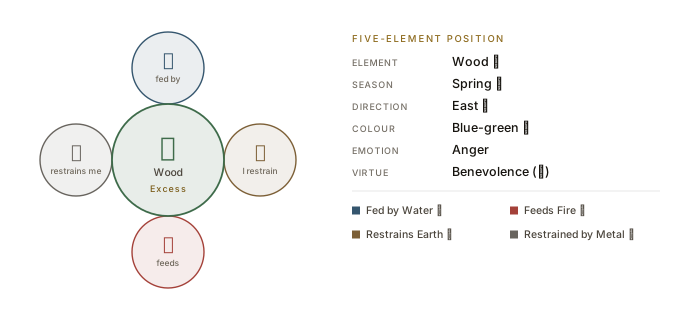
At a glance
Excess Wood reads as overgrowth: a chart that will not stop expanding and has nothing in it that will prune.
In the classical correspondence tables Wood governs spring and the east, the liver and gallbladder, the eyes, and the sour taste.
What too much Wood looks like
The classical image is a tree that has outgrown its container. Roots crack the pot, the canopy blocks its own light, and the problem is not vigour but proportion. In a person this shows as rigidity: positions held past the point where holding them costs more than moving, and a temper that arrives with a kind of righteousness attached, because the phase genuinely believes it is defending something true.
The body picture follows: headaches, tendon tension, red or dry eyes, irritability with a short fuse, and in the stronger pictures the classical liver-fire signs. The taste correspondence is where the tradition makes its most practical point — sour gathers and holds, and a chart that is already over-constrained does not need more of that quality.
What drains excess Wood is Metal, and this is the correspondence people find least intuitive and most useful. Metal is the axe, the rule, the boundary, the thing that says no. For an overgrown Wood chart the intervention is not more space to grow; it is a smaller container with clearer walls. Fire helps too, in a different way: it spends the growth on something visible, which is why overgrown Wood often calms down when it has an audience and a deadline.
What causes it, and what drains it
What causes it
Too much Water feeding it, a spring birth, several Wood characters with roots in the branches, or a long stretch of life with no consequences — which produces the same rigidity without a chart.
What drains it
Metal first: structure, limits, a rule that applies to you too. Then Fire: output, exposure, finishing something in public. Cutting back on Water is the third lever and the one people skip.
Where an excess of Wood shows first
sour
wind
east
anger
How much weight this carries
The same caveat as deficiency, in the other direction: excess is read against the rest of the chart. An element that looks excessive in isolation is often just well supported, and an element that looks strong because it has 3 and 8 in the chart may have nothing behind it.
Related Concepts
Common questions
Is excess Wood a good problem to have?
It is a problem with obvious upsides — energy, initiative, principle — and a predictable cost: the parts of life that need patience get neglected, and the person usually notices last.
How do you tell excess from strength?
By what the chart can support. Wood with Water behind it and Metal to shape it is strong; Wood with neither is overgrown. The difference is not the amount, it is the structure around it.
Does excess Wood mean an angry person?
It means anger is closer to the surface. Whether it is expressed depends on the rest of the chart — some of the most controlled people are running an overgrown Wood they are holding down.
Explore more
Want this applied to your own chart?
The database explains the symbol. A reading connects it to your birth data — BaZi, Zi Wei, element balance, and the symbols that keep recurring.
See personalized readings →