Wood in Feng Shui
In a room, Wood is living growth: plants, height, and the direction of morning light. Almost everything else sold as 'wood element' in feng shui writing — brown furniture, wooden floors, green paint — is either a different phase or a different category altogether.
木 Mù · spring · east
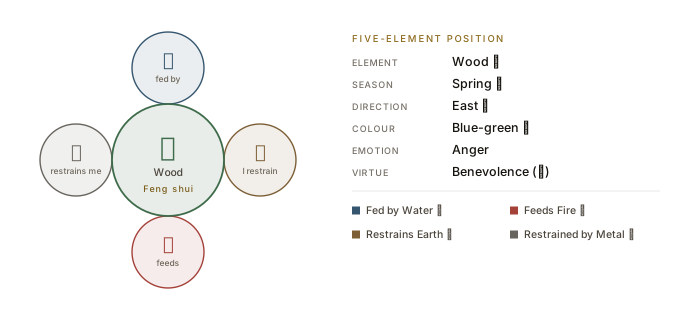
At a glance
In a room Wood is living growth — plants and height on the east side, not furniture.
In the classical correspondence tables Wood governs spring and the east, the liver and gallbladder, the eyes, and the sour taste.
Wood in a room
The working distinction is between a thing that grows and a thing that was grown. A plant in the east corner is Wood; a mahogany desk is an object made of former Wood, and the tradition reads it as structure and wealth rather than as growth. This is not pedantry. The correspondence is meant to mark where the phase is active, and a finished object is where the phase has stopped.
Room by room, the logic stays the same: the east side of the room you use in the morning, the corner where work begins, the sill that gets light. Wood is placed where a person is trying to start something, not where they are trying to rest — the bedroom is the wrong room for it, and the classical texts are consistent on that point.
Corrections are mostly subtractive. Dead plants out, dried arrangements out, and anything that represents growth without doing it removed from the east side. Then one living thing, in the right place, kept alive — which is the part of feng shui nobody sells, because it requires maintenance rather than purchase.
Room by room
Room by room
Study and workspace: a plant on the east side, at the height where it is seen from the desk. Living room: one substantial growing thing, not a collection. Bedroom: none — the phase is for starting, not for sleeping.
Corrections
Remove dead and artificial plants from the east. Do not treat furniture as the Wood element. If the east is a bathroom or a stairwell, place the living thing in the room you actually start your day in.
Objects and placements
east
blue-green
tall and columnar
Jupiter
How much weight this carries
Feng shui claims are the hardest to test and the easiest to sell, which is exactly why this page stays descriptive. The classical correspondences (east, blue-green) are consistent across schools; the claims about outcomes are not, and no arrangement here substitutes for a working lock, a smoke alarm, or daylight.
Related Concepts
Common questions
Do plants really count as feng shui?
In this system, yes — they are the clearest case of the Wood correspondence being literally true. Whether that changes outcomes is a separate claim, and a much weaker one.
How many plants is too many?
When the room reads as overgrown. The tradition treats excess Wood as a real problem, and a jungle in a small room is the domestic version of it.
Should I use green in the east?
Only if the chart is short of Wood. Colour is a dose, and the east corner of a Wood-heavy household does not need more of the same signal.
Explore more
Want this applied to your own chart?
The database explains the symbol. A reading connects it to your birth data — BaZi, Zi Wei, element balance, and the symbols that keep recurring.
See personalized readings →