Wood and Food
The taste the tradition assigns to Wood is sour, and the assignment is about a quality rather than a flavour preference. Sour gathers and holds — it is the taste that pulls inward — and Wood is the phase that is trying to move outward, so the two are in tension by design.
木 Mù · spring · east
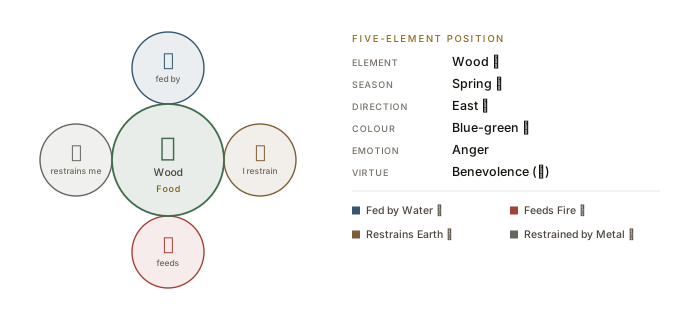
At a glance
Wood's taste is sour — a quality that gathers and holds, assigned to the phase that wants to move.
In the classical correspondence tables Wood governs spring and the east, the liver and gallbladder, the eyes, and the sour taste.
The taste the tradition gives Wood
That tension is the whole point. A small amount of sour is read as structuring: it keeps growth from scattering. Too much is read as constraint, and the classical texts are specific about the consequence — an excess of sour is said to over-control Earth, which in the body map is the spleen and the digestion. This is the five-element logic in its purest form: the problem with too much of one taste is not that it is unhealthy in itself, it is that it displaces the phase that would balance it.
The foods the tradition places in Wood are the green, upward, spring things: leafy vegetables, sprouts, young greens, and the wheat that the correspondence tables assign as Wood's grain. The cooking method matters as much as the ingredient — brief heat, little time, the thing still recognisably a plant — because a long-stewed green is being read as a different phase entirely.
What drains Wood in this scheme is not a food but a pattern: heavy, rich, slow food taken in quantity, which is read as Earth and Water overwhelming a phase that wants light material to grow on. The practical translation is unglamorous and probably right — if a Wood-heavy person feels sluggish and irritable, the first thing to check is not which supplement is missing but whether every meal is a heavy one.
What feeds it, what drains it
What feeds it
Young greens, sprouts, sour in small amounts, wheat, and food that is cooked briefly and eaten soon. The pattern is lightness and direction rather than any specific ingredient.
What drains it
Heavy, slow, sweet and rich food in quantity, and long cooking that removes the upward quality. The tradition reads this as Earth and Water suppressing a phase that needs to rise.
The Wood table
sour
wheat
wind
liver
How much weight this carries
Dietary correspondences are the place where five-element thinking is most often confused with nutrition. Wood foods are not automatically good for liver in any medical sense. What the tradition actually does is assign a taste and a temperature to foods and ask whether the chart needs more or less of that quality.
Related Concepts
Common questions
Are sour foods good for the liver?
In this system sour is assigned to Wood, which governs the liver, but 'assigned to' is not 'good for'. The classical position is that a little structures and a lot constrains.
Why is wheat the Wood grain?
Because the correspondence tables assign the five grains to the five phases, and wheat — sown in autumn, rising fast in spring — is the one given to Wood. The reasoning is seasonal, not nutritional.
Should I eat by my element?
The tradition would say eat by your chart's need, which is not the same as eating by your element. A Wood-heavy chart usually needs less Wood food, not more.
Explore more
Want this applied to your own chart?
The database explains the symbol. A reading connects it to your birth data — BaZi, Zi Wei, element balance, and the symbols that keep recurring.
See personalized readings →