Wood and Health
In the classical body map Wood governs the liver and the gallbladder, opens into the eyes, controls the tendons, and is disturbed by anger. The point of the map is organisation, not diagnosis: it groups symptoms that tend to move together and gives a practitioner a vocabulary for asking what else is going on.
木 Mù · spring · east
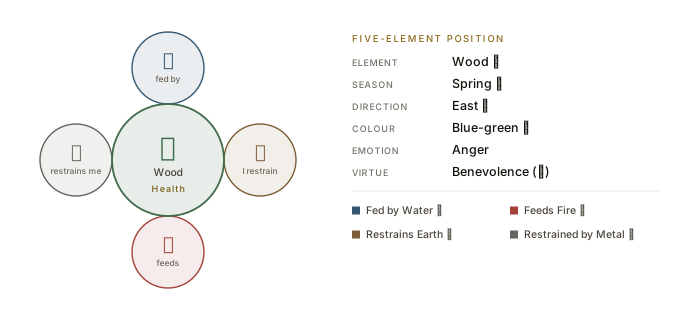
At a glance
In the classical body map Wood governs the liver and gallbladder, the eyes, the tendons, and the emotion of anger.
In the classical correspondence tables Wood governs spring and the east, the liver and gallbladder, the eyes, and the sour taste.
The body map the tradition assigns to Wood
The liver's job in this scheme is free movement. It is not the organ of detoxification in the modern sense; it is the thing that keeps qi from stagnating, and stagnation is the failure the tradition cares about. That is why the emotional correspondence is anger rather than, say, fear: a stuck phase produces pressure, and pressure produces irritability. The classical description of liver stagnation — sighing, a lump in the throat, rib-side fullness, irritability — is a description of a system that wants to move and is being held.
The eye and tendon links follow the same logic. Wood is the phase that stretches and extends, so the tissues it governs are the ones that stretch: tendons, sinews, the apparatus of movement. Eye strain and tendon tightness are read as the same kind of problem in different tissue, which is why the traditional advice for both is movement rather than rest — a held position is the enemy.
The gallbladder carries a different nuance. In the classical literature it is the organ of decision, and a timid, indecisive picture is described as gallbladder deficiency rather than as a character flaw. Whatever one makes of the physiology, the observation underneath is useful: the same phase that governs starting things also governs the capacity to choose.
Signs of imbalance
Signs of imbalance
Irritability that arrives faster than the situation deserves; sighing without noticing; tight shoulders and hamstrings; eyes that tire early; headaches behind the eyes; a decision that will not close. None of these is specific to Wood, which is precisely why the map is read alongside the rest of the chart.
What the tradition recommends
Movement over stasis, sour in moderation, and the late-evening rest the classical texts assign to the liver hours. The one item worth keeping from the list regardless of belief is the first: a stuck phase is treated by moving, not by resting harder.
Wood in the body
liver
gallbladder
eyes
tendons and sinews
anger
sour
How much weight this carries
This is the weakest claim on the site, and it should be stated plainly. The correspondences (liver, gallbladder, eyes, sour) are a classical map of relationships between categories, not a description of organs. They were built to organise symptoms, not to diagnose them. Anyone with an actual symptom should see a doctor, and no page here should delay that.
Related Concepts
Common questions
Does a Wood chart mean liver problems?
No. The correspondence groups a category of symptoms; it does not predict disease, and it is not a substitute for a blood test. This page describes how the tradition organises the body, nothing more.
Why is anger assigned to the liver?
Because anger is what a blocked phase feels like from inside — pressure without an outlet. The assignment is about the shape of the experience, not about causation.
What actually helps a stuck Wood picture?
In the tradition, movement, stretching, and resolving the thing being avoided. In practice that is also the answer most people arrive at without the chart.
Explore more
Want this applied to your own chart?
The database explains the symbol. A reading connects it to your birth data — BaZi, Zi Wei, element balance, and the symbols that keep recurring.
See personalized readings →