Wood in Relationships
Wood attaches directly. There is very little theatre in it: the interest is stated, the intention is stated, and the absence of elaboration is not coldness — the phase simply does not think of courtship as a separate activity from the relationship itself.
木 Mù · spring · east
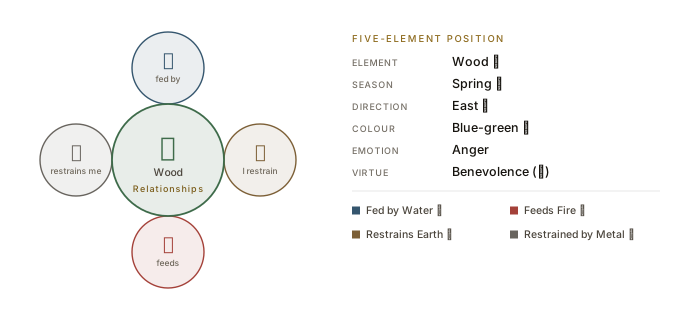
At a glance
Wood attaches directly and expects the same in return; the friction is usually about who decides.
In the classical correspondence tables Wood governs spring and the east, the liver and gallbladder, the eyes, and the sour taste.
How Wood attaches to people
What Wood assumes is reciprocity of effort rather than reciprocity of feeling. Two people can be equally committed and still fail this test, because Wood is counting contributions and the other person is counting attention. The recurring complaint from partners is not that Wood is unfaithful or unkind; it is that Wood is already somewhere else, mentally, while physically present.
The conflict style is the real signature. Wood negotiates positions and is genuinely bad at negotiating feelings — not unwilling, badly equipped. Asked what they are upset about, a Wood chart will describe the disagreement; asked how it made them feel, they will describe the disagreement again with more emphasis. Partners read this as deflection. It is closer to a missing channel.
The thing Wood needs and rarely asks for is permission to stop growing for a while. A relationship with a Wood chart often becomes another project — something to be improved, scheduled, optimised — and the phase does not notice it has done this until someone says so. The correction is not less effort. It is effort that does not have a goal attached.
What it needs, and where it rubs
What it needs
Directness, and a partner who says what the problem is instead of waiting to be understood. Wood reads hints badly and reads plain statements well, which makes it easier to live with than its reputation suggests.
Where it rubs
Being told to slow down, and being asked to sit with a feeling rather than fix it. Both requests are legitimate and both land as accusations, because the phase hears 'stop' as 'you are wrong'.
How Wood meets the other four
Wood generates Fire — Wood is the fuel; the relationship is about giving something up so that something else can become visible.
Wood controls Earth — Wood restrains Earth the way roots hold soil — structure rather than destruction.
Wood is controlled by Metal — Metal is the axe: it shapes Wood, and Wood resents it while depending on it.
Wood is generated by Water — Water is the supply Wood does not control — support with a string attached.
How much weight this carries
Element compatibility is a description of friction, not a verdict on a relationship. Two people with difficult elements marry and do fine; two with easy ones separate. What the system predicts reliably is the shape of the argument they will have, not whether they will have it.
Related Concepts
Common questions
Who is Wood most compatible with?
Water feeds it and Fire gives it somewhere to go, so both are traditionally easy. The easy pairing is not automatically the good one — see the pages on each pair for what the ease costs.
Why does Wood leave before the argument is over?
Because the phase treats an unresolved problem as an unfinished task, and unfinished tasks are intolerable. Leaving is usually an attempt to end the discomfort, not to end the relationship.
Can a Wood chart be happy with another Wood chart?
Yes, with a specific risk: two phases that both grow and neither prunes will escalate. It works when they are growing in different directions and can see each other's progress.
Explore more
Want this applied to your own chart?
The database explains the symbol. A reading connects it to your birth data — BaZi, Zi Wei, element balance, and the symbols that keep recurring.
See personalized readings →