Wood and the Season
Wood governs spring, and in the calendar the tradition actually uses the season does not begin on 1 January. The BaZi year turns at 立春, the 'start of spring' solar term in early February, which is why someone born in late January belongs to the previous year's animal.
木 Mù · spring · east
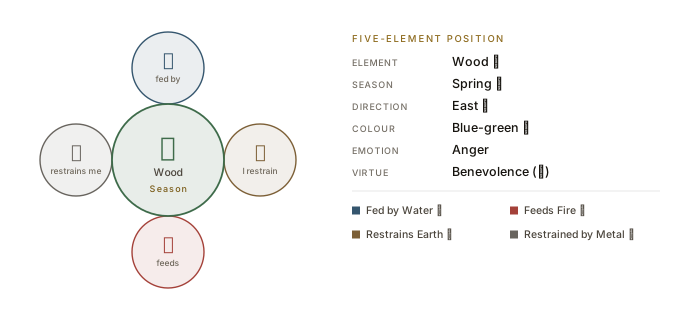
At a glance
Wood governs spring — and in the chart calendar the year turns at 立春 in early February, not on 1 January.
In the classical correspondence tables Wood governs spring and the east, the liver and gallbladder, the eyes, and the sour taste.
Wood and spring
Spring in this system is not a mood, it is a phase with a job: starting. The classical calendar divides the year into twenty-four solar terms and the seasons into seventy-two-day blocks, and the Wood block is the one where the year's direction is set. The practical instruction that follows is unusually concrete — begin things in spring, do not expect to harvest in spring, and do not judge a spring decision by its autumn result.
The three Wood months are 寅, 卯 and 辰, roughly February to April. 寅 is the first month and carries the strongest Wood; 卯 is Wood at its purest, the month where the phase is least mixed; 辰 is the transition month, technically Earth, where the season hands over. That last point is the one people miss: the third month of spring is not Wood, and a chart born in it reads differently from one born a month earlier.
For a person rather than a calendar, the correspondence is about timing appetite. A Wood-heavy chart tends to be most itself in the first part of any cycle — the first year of a job, the first months of a project, the beginning of a relationship — and to experience the later, steadier part as a kind of waiting. Knowing this does not change the phase, but it changes what a person plans for.
What the season asks of you
What the season asks of you
To start, and to tolerate the fact that starting looks like mess. The classical instruction for spring is that the shape of the year is decided now, and that judging the shape before summer is a category error.
The month boundaries
寅 from 立春, 卯 from 驚蟄, 辰 from 清明 — each roughly the 4th to 6th of the month. A birth date within a day of a boundary is why practitioners ask for the hour as well as the date.
The season in correspondences
spring
春
wind
3 and 8
How much weight this carries
The seasons are the original evidence for the whole scheme — the cycle was read off the year before it was ever applied to a person. That is also its limit: a season is a phase everyone passes through, while a chart is a particular arrangement of phases.
Related Concepts
Common questions
Why does the Chinese year start in February?
Because the solar calendar used for charts is tied to 立春 rather than to the lunar new year. The two usually fall close together, which is why the difference is so often missed.
Is a spring birth automatically Wood-heavy?
The month branch is Wood, which is a real contribution, but the day master and the rest of the chart can outweigh it. Season is one input, not a verdict.
What is 辰 if it is a spring month?
It is the handover month: the season is ending and Earth is present. It is why the last month of each season is read as Earth rather than as the season's own element.
Explore more
Want this applied to your own chart?
The database explains the symbol. A reading connects it to your birth data — BaZi, Zi Wei, element balance, and the symbols that keep recurring.
See personalized readings →