Weak Wood
A weak Wood chart reads as hesitation. The plans exist and are often good; the starting is what fails. This is different from laziness and different from fear — the phase simply does not have enough pressure behind it to overcome the first obstacle.
木 Mù · spring · east
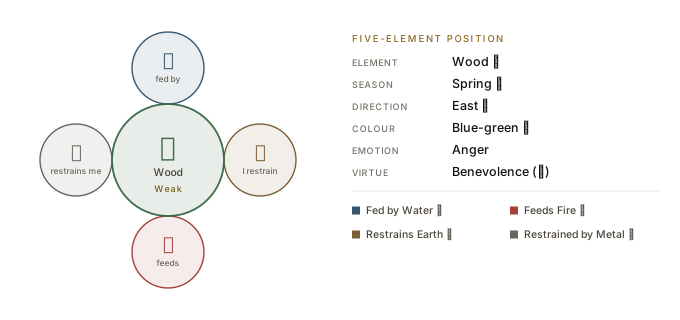
At a glance
A weak Wood chart reads as hesitation: plans that never start and decisions deferred until the option closes.
In the classical correspondence tables Wood governs spring and the east, the liver and gallbladder, the eyes, and the sour taste.
What a weak Wood looks like
The classical markers are the ones you would predict from the organ map, read backwards: indecision, a tendency to defer choices until the option closes on its own, eye fatigue, weak or cramping tendons, and a kind of low-grade irritability that has no target. The gallbladder correspondence is the one to watch, since timidity in the specific sense of being unable to commit to a direction is the signature of the deficient picture.
The causes are structural rather than moral. Wood is fed by Water and cut by Metal; a chart with too much Metal and no Water behind the Wood is being pruned faster than it grows. Being born in autumn produces a version of this, as does a chart where the Wood is present but unsupported — a stem with no root, which is the classical image for a phase that exists on paper only.
The restoration is not 'more Wood' in the crude sense. The tradition adds Water first — support, rest, reserves, the thing that makes growth possible — and reduces Metal, which in practice means fewer constraints, fewer critics, and less structure imposed from outside. Then it adds a small, finite, finishable project, because a weak Wood chart rebuilds confidence by completing something rather than by planning something larger.
What causes it, and what restores it
What causes it
A Metal-heavy chart with no Water; an autumn birth; a Wood stem with no root in the branches; or years of an environment that punished initiative, which produces the same picture without any astrology at all.
What restores it
Water before Wood: sleep, reserves, and support that does not come with a deadline. Then one small thing finished. Then another. The order matters — asking a weak Wood chart to start something big is how the deficiency gets worse.
Where a deficient Wood shows first
sour
wind
spring
3 and 8
How much weight this carries
Deficiency is a property of a whole chart, and it is diagnosed by a practitioner looking at all four pillars — not by matching symptoms to a list. The signs below are the classical markers. Treat them as questions to ask, not answers.
Related Concepts
Common questions
How is a weak Wood chart diagnosed?
By a practitioner reading all four pillars: whether the Wood has support in the branches, what season it was born into, and what is cutting it. The symptom list alone cannot do it.
Is weak Wood the same as low confidence?
Overlapping, not identical. Confidence is a mood; the deficient picture is about capacity to move. People with plenty of confidence can still have a chart that will not start.
Does a weak element mean a weak person?
No, and this is the most common misreading of the system. A deficient phase describes a gap in the chart's balance, not a judgement about the person carrying it.
Explore more
Want this applied to your own chart?
The database explains the symbol. A reading connects it to your birth data — BaZi, Zi Wei, element balance, and the symbols that keep recurring.
See personalized readings →