The Timing Layer in Zi Wei Dou Shu: Decades, Years and Transformations
A natal chart is a snapshot. The timing layer is what turns it into a calendar — how the ten-year periods are set, how a year activates specific stars, and where the method runs out of road.
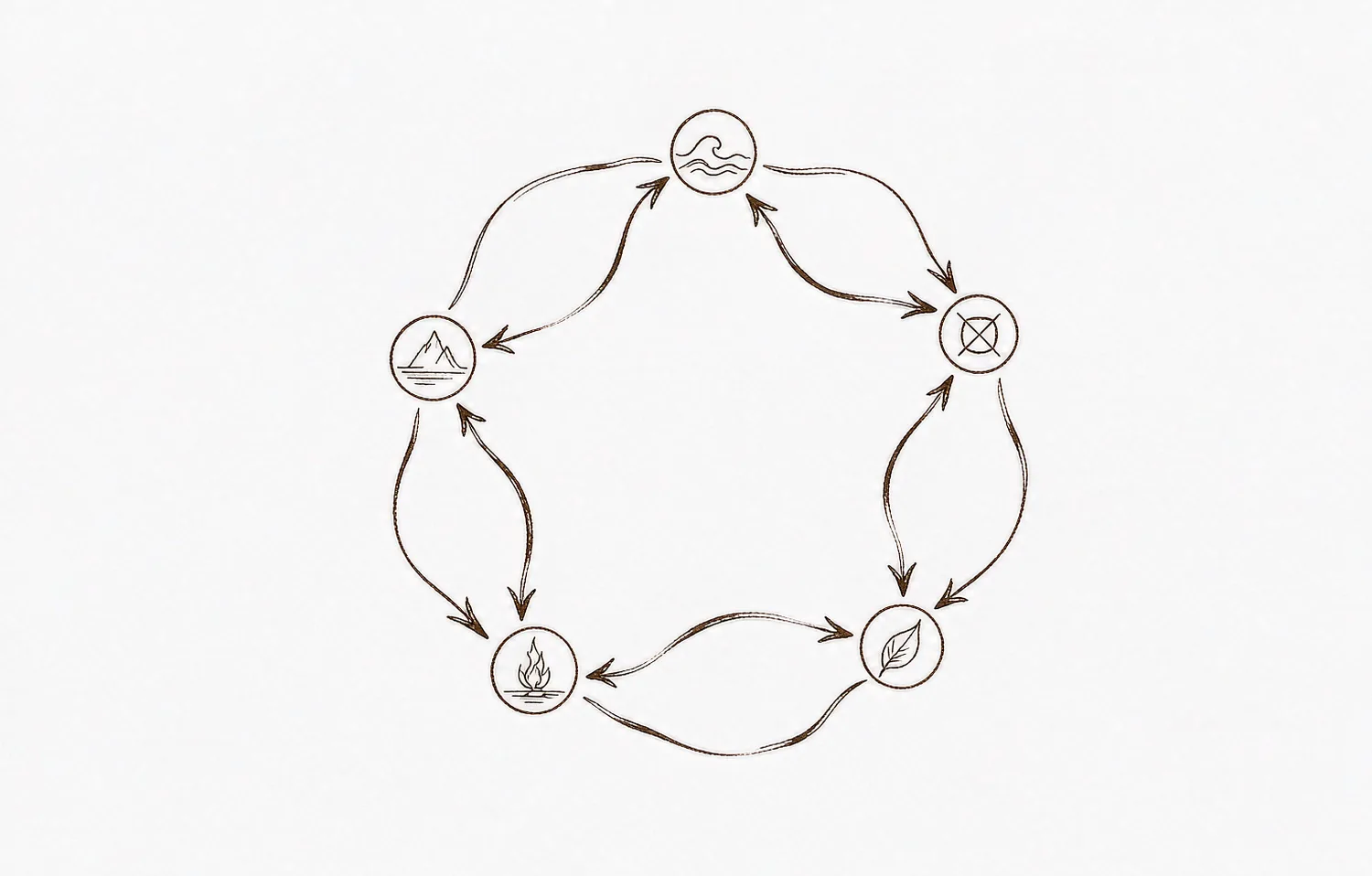
A Zi Wei chart on its own describes structure. What most people actually want to know is timing — why this year feels different from the last one. Zi Wei answers that with a layered system: a natal chart at the bottom, ten-year periods on top of it, and annual activations on top of those.
It is a genuinely useful framework, and it is also the layer where overclaiming is easiest. Here is how the layers are built, and where the honest limits sit.
The ten-year period (大限)
The chart is divided into twelve palaces, and each palace governs a ten-year stretch of life. The sequence starts at an age set by the Five Element Bureau — which is why the bureau matters even though it never appears in an interpretation — and it runs either forward or backward through the branches depending on the year's polarity and whether the person is male or female.
As the decades advance, the palace that counts as the Life Palace rotates. That is the important mechanical consequence: a reading is not 'star X in my Life Palace forever' but 'the decade I am in makes palace Y the reference point, and here is what sits there'.
One thing worth noticing: the rotation is arithmetic. It will happily tell you something about your seventies. Whether the description is useful at that range is a separate question from whether the mechanics run, and practitioners usually treat far-future decades as context rather than forecast.
The annual layer (流年)
| Year stem | 化禄 Lu | 化权 Quan | 化科 Ke | 化忌 Ji |
|---|---|---|---|---|
| 甲 Jia | 廉贞 | 破军 | 武曲 | 太阳 |
| 乙 Yi | 天机 | 天梁 | 紫微 | 太阴 |
| 丙 Bing | 天同 | 天机 | 文昌 | 廉贞 |
| 丁 Ding | 太阴 | 天同 | 天机 | 巨门 |
| 戊 Wu | 贪狼 | 太阴 | 右弼 | 天机 |
| 己 Ji | 武曲 | 贪狼 | 天梁 | 文曲 |
| 庚 Geng | 太阳 | 武曲 | 太阴 | 天同 |
| 辛 Xin | 巨门 | 太阳 | 文曲 | 文昌 |
| 壬 Ren | 天梁 | 紫微 | 左辅 | 武曲 |
| 癸 Gui | 破军 | 巨门 | 太阴 | 贪狼 |
The year has its own sexagenary stem and branch, and both are used. The branch locates the year's palace on the natal grid, which is how a chart produces a different emphasis every year without anything in the natal chart changing.
The stem is what activates the Four Transformations. Because the transformations are assigned by heavenly stem, each year's stem transforms a fixed set of stars: one carries abundance, one authority, one reputation, one obstruction. Those transformed stars are then read wherever they happen to sit in the natal chart, which is why the same year describes differently for two people born in the same animal year.
This is the part of Zi Wei that is most specific and most testable. It is also the part most often overstated: a transformation landing on a star indicates a theme becoming active, not an event being scheduled.
Small periods and the monthly layer
Beyond decades and years, some traditions layer in monthly periods and the 小限, a separate one-year-at-a-time cycle that runs independently of the decade rotation. Schools differ on which of these to use and how to weight them against each other.
The practical effect is that two competent practitioners can describe the same month differently while using the same chart, because they are reading different sub-layers. That is not a defect to be fixed; it is a known feature of a transmitted system. It does mean that any claim about a specific month should be treated as the softest claim in the whole reading.
Where the method runs out
Three honest limits. First, the timing layer describes activation and emphasis, not events. It can tell you that a theme is live; it cannot tell you what you will do about it, and your choice is not in the chart.
Second, precision is coarse. Two-hour birth resolution, calendar conventions that vary by lineage, and a monthly layer that schools weight differently all mean that fine-grained predictions are not supported by the method — even when a confident reading is offered.
Third, the tradition is not a validated empirical system. It is a coherent symbolic language for thinking about timing, refined over a long time by people paying close attention. That is worth something. It is not the same as a forecast, and anyone selling it as one is selling something the method does not contain.