The You Branch (酉) — Rooster, Metal
You is the second metal branch and the only one with a single hidden stem. Pure Yin metal — 辛, jewellery rather than the axe — which gives the branch an exactness that none of the others have. Where Shen cuts, You measures, and the difference shows up in every chart it appears in.
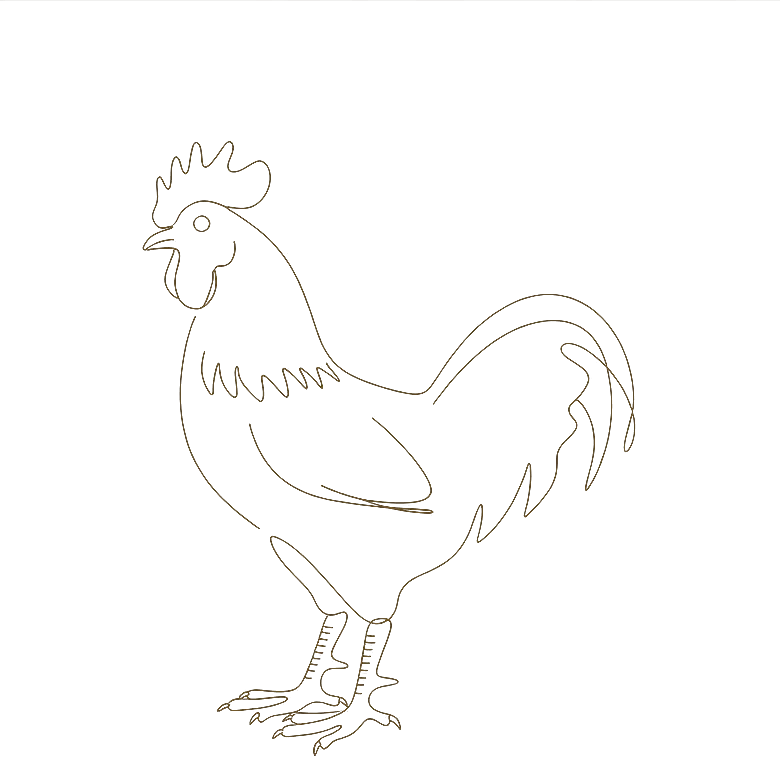
What the 酉 branch is
酉藏辛 alone. The absence of a second stem is significant: You has no internal tension, no minority voice, no fallback. Whatever the branch is, it is that entirely. This is the source of both its clarity and its difficulty — 辛 metal will not do an approximate version of anything, and a chart with You prominent rarely compromises on how something should be done.
The branch governs mid-autumn, the equinox month, when day and night are equal. Classical readings treat You as the branch of balance achieved through precision rather than through moderation: not the middle of the road, but everything in exactly the right place. In practice, charts with strong You tend to belong to people with a very specific sense of how things should look and a low tolerance for the version that is merely acceptable.
You's confrontation with Mao (the Rooster and Rabbit branches) is one of the clearest opposition pairs in the system: metal against wood, polished edge against growing thing. Charts carrying both often describe people who are permanently caught between their standards and their circumstances.
From the inside
From the inside, You feels like a continuous, quiet audit. You notice the misaligned thing in the room, the wrong word in the sentence, the figure that does not reconcile — and the noticing is automatic and not especially welcome, because you cannot switch it off and you know that mentioning it will not always be received well. There is also a private, more painful part: the same standard you apply outward is applied to yourself at higher resolution, and the gap between your work as it exists and your work as it should be is the most familiar landscape in your life.
Hidden stems in You
| Hidden stem | Element | English | Polarity | Rank |
|---|---|---|---|---|
| Xin 辛 | 金 | Metal | Yin | main qi |
酉藏辛 alone. Xin (Yin Metal) is the finished object: jewellery, instruments, precision tools. Because it is the only voice in the branch, You supplies the cleanest metal in the system — and a chart that draws metal from You gets refinement rather than force.
How You relates to the other branches
| Relationship | Partners | What it means |
|---|---|---|
| Six Harmony (六合) | Chen 辰 | A fixed pairing read as natural rapport — the classical “good match” relationship between two branches. |
| Three Harmony (三合) | Chou 丑 · Si 巳 | Same elemental trine. Two branches of a three-branch combination share an element and are read as reading each other's instincts correctly. |
| Clash (冲) | Mao 卯 | Direct opposition, six positions apart. Read as movement and friction rather than as misfortune — the branches pull in opposite directions. |
| Harm (害) | Xu 戌 | Harm. A quieter relationship than clash — small ongoing friction that compounds if unaddressed. |
| Break (破) | Zi 子 | Break. The least discussed of the branch relationships: a destabilising pairing, classically read as undermining rather than opposing. |
| Self-punishment (自刑) | You 酉 (repeated) | The same branch repeating. For Chen, Wu, You and Hai this is self-punishment — read as an internal dynamic rather than a clash with another person. |
Where You is strong
- Standards that hold. You maintain a quality threshold regardless of who is watching. In any field where the last 5 percent matters, this is the whole job.
- Perception of detail. You see what has changed in a document, a face or a room without looking for it.
- Craft discipline. You are willing to do the same thing again until it is right. This is what separates competent people from practitioners.
- Honesty about quality. You do not flatter work, including your own. People trust your assessment precisely because it is not designed to be pleasant.
Where it goes wrong
- Perfectionism as a delay. The finishing stage can stretch indefinitely, and shipping late is still shipping badly.
- Criticism with no cushion. You report the finding accurately and omit the context. The information is correct; the delivery costs you allies.
- Standards that isolate you. If the standard is high and unstated, the people around you learn to avoid showing you unfinished work — which is exactly the work you are best at improving.
- Impatience with the unpolished. Some things need to be rough before they can be good. You are prone to discarding a promising early draft.
The 17:00–19:00 birth hour
The You hour (17:00–19:00) is dusk — the hour when the day's work is reviewed. Hour-pillar You charts often describe people who do their sharpest thinking at the end of the day rather than at the beginning.
In traditional medicine the branch is also assigned to lungs, throat and the respiratory system, which is why classical texts read chronic conditions through the branch that governs the season they began in.