The Zi Branch (子) — Rat, Water
Zi is the first branch and the coldest position on the clock. It is Yang water sitting at the top of a Yin season — the exact point where the old year ends and the new one has not started yet. Everything about Zi comes from that position: it is the branch of beginnings that happen in the dark.
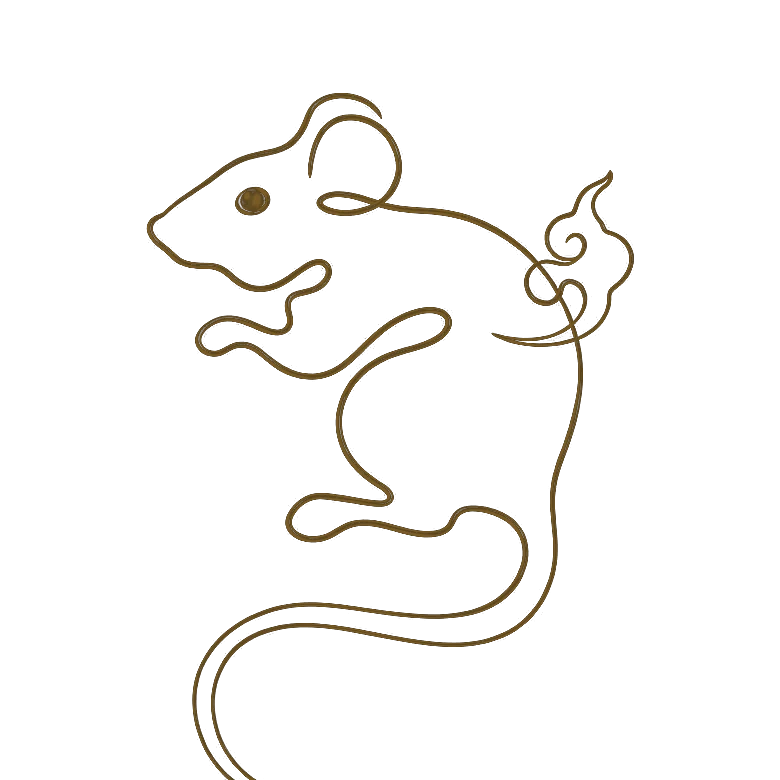
What the 子 branch is
子 is the eleventh month of the Chinese calendar, the month containing the winter solstice. Yang is nominally reborn here, but nothing visible has changed — the ground is frozen, the trees are bare. So Zi carries a signature that is easy to misread from the outside: it looks passive and is actually the most active point in the cycle, because the turn has already happened underground.
This is why the branch belongs to the Rat rather than to something grander. The Rat is the animal that survives winter by being small, quick, and awake when everything else is asleep. As a branch, Zi means resourcefulness under scarcity — the ability to find the one opening in a closed situation.
In a chart, Zi is also the branch that produces the most discussion, because it contains only one hidden stem (Gui, Yin Water) and no mid-qi or leftover qi. It is the cleanest branch in the system: one voice, one direction. Charts heavy in Zi tend to belong to people whose private reasoning is far more developed than it appears from how much they say.
From the inside
From the inside, a Zi-heavy chart feels like always being one step ahead of the conversation and rarely saying so. You notice the option nobody has mentioned yet, and you usually wait to see whether anyone else gets there. The frustration is specific: you are not withholding, you are waiting for the right moment to introduce something, and the right moment keeps not arriving. People conclude you are either secretive or easy-going. Neither is accurate. You are simply running a longer calculation than the room is.
Hidden stems in Zi
| Hidden stem | Element | English | Polarity | Rank |
|---|---|---|---|---|
| Gui 癸 | 水 | Water | Yin | main qi |
子藏癸 alone. A single hidden stem means the branch has no internal argument — what it is, it is all the way through. When Zi is the month branch, Gui water is at full strength and the whole chart is being read in a winter key.
How Zi relates to the other branches
| Relationship | Partners | What it means |
|---|---|---|
| Six Harmony (六合) | Chou 丑 | A fixed pairing read as natural rapport — the classical “good match” relationship between two branches. |
| Three Harmony (三合) | Chen 辰 · Shen 申 | Same elemental trine. Two branches of a three-branch combination share an element and are read as reading each other's instincts correctly. |
| Clash (冲) | Wu 午 | Direct opposition, six positions apart. Read as movement and friction rather than as misfortune — the branches pull in opposite directions. |
| Punishment (刑) | Mao 卯 | Punishment. Two or three branches in a relationship classically read as internal pressure, obligation and repeated friction. |
| Harm (害) | Wei 未 | Harm. A quieter relationship than clash — small ongoing friction that compounds if unaddressed. |
| Break (破) | You 酉 | Break. The least discussed of the branch relationships: a destabilising pairing, classically read as undermining rather than opposing. |
Where Zi is strong
- Early sight. You see the shape of a problem before it has a name. In projects this shows up as the person who asks the awkward question in week one rather than week ten.
- Low-profile resilience. You do not need conditions to be good in order to function. Zi charts tend to produce people who quietly keep going through periods when everyone else has stopped.
- Reading the room without effort. Water takes the shape of its container. You naturally know what a situation requires and can adjust before anyone has explained it.
- Ideas that arrive fully formed. Your best thinking happens off-stage and shows up complete, which is why you are rarely credited for the work of getting there.
Where it goes wrong
- Waiting past the window. The same patience that lets you see the turn early also lets you sit on it until the opportunity has closed. Your timing errors are almost always late, not early.
- Coldness mistaken for calm. You process emotionally at the same speed you process everything else — slowly and privately. People read the delay as indifference.
- Underclaiming. Zi does not push forward to be seen. Over a career, that habit costs more than any single bad decision.
- A single point of failure. With only one hidden stem, there is no fallback voice. When your read of a situation is wrong, it is wrong in a way you cannot easily argue yourself out of.
The 23:00–01:00 birth hour
Born between 23:00 and 01:00, the hour pillar is Zi. The Chinese day rolls over at 23:00, not midnight, so a birth at 23:30 belongs to the next day — the single most common manual calculation error in BaZi.
In traditional medicine the branch is also assigned to kidneys and bladder, which is why classical texts read chronic conditions through the branch that governs the season they began in.