Wood (木) in Chinese Astrology
Wood is the element of beginning — the direction-setting force in the system. It is not the strongest element and it is usually the one that determines what happens next, because Wood is the only element whose job is to commit to a direction before the outcome is known.
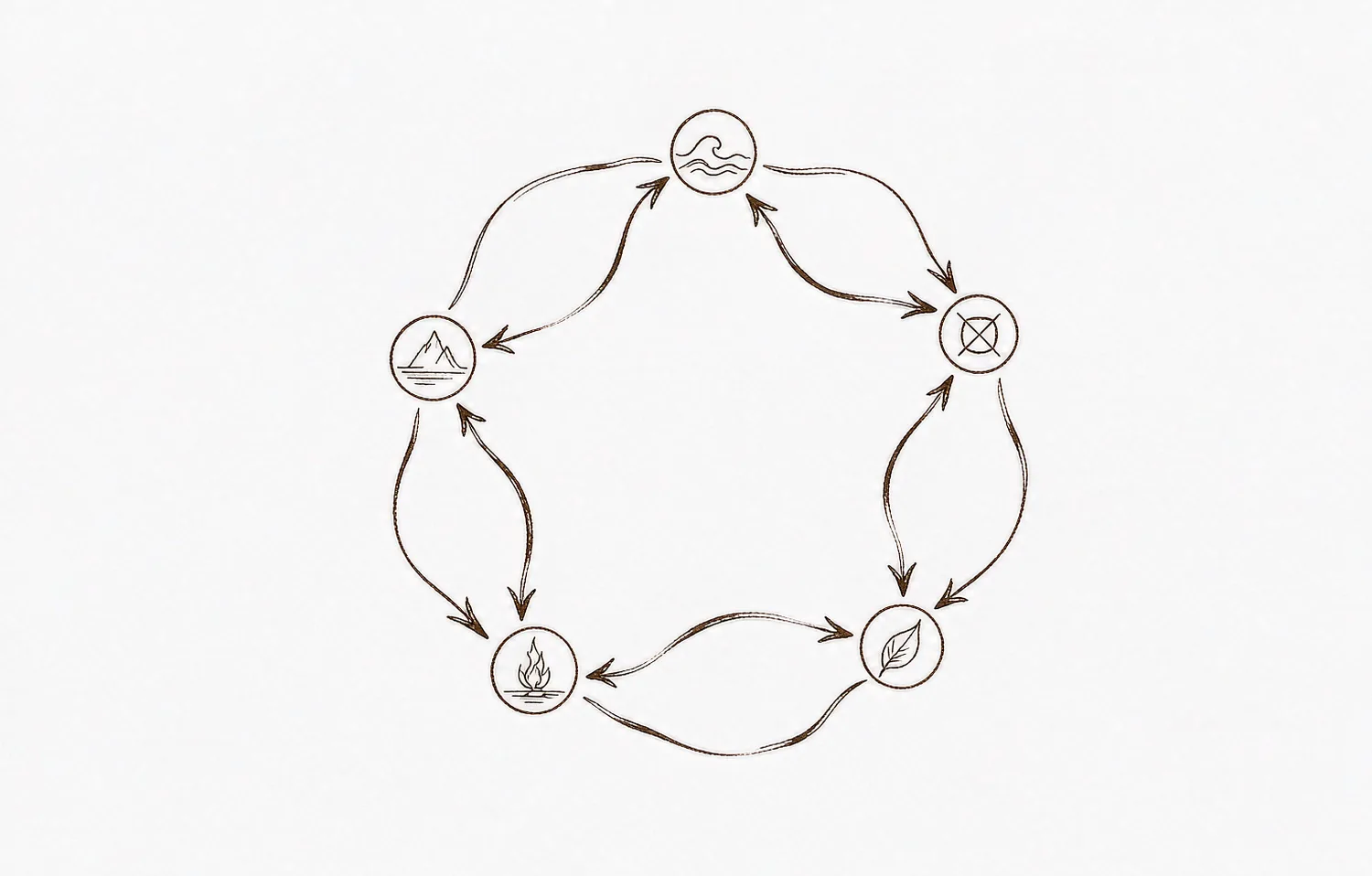
What Wood does
木 is growth with an axis. That is the difference between Wood and the other expanding element, Fire. Fire spreads in every direction and lights whatever it touches; Wood goes one way, upward, and treats every obstacle as something to be grown around rather than a reason to reconsider. In chart terms, Wood dominant means the person organises around a direction rather than around an opportunity.
The generating cycle gives Wood its second role. Wood feeds Fire — output comes from direction — which is why the classical texts treat Wood as the source of all productive work rather than as a personality type. A chart that cannot generate Wood is a chart that struggles to start, whatever else it has.
The controlling cycle gives Wood its third. Wood parts Earth, so Wood is the element that moves the ground: it breaks up settled structures, opens what has been compacted, and makes room. Every constructive challenge to an established order in a chart is being run by Wood, which is why it is simultaneously the element of visionaries and the element of people who cause problems for institutions.
From the inside
From the inside, Wood feels like direction arriving before argument. You know what you are aiming at long before you can justify it to anyone, and the justification is a translation exercise rather than a discovery. There is also a specific texture to Wood's difficulty: you are rarely blocked by external obstacles and frequently blocked by your own unwillingness to change the aim. What looks like persistence from outside is often the absence of an alternative you would accept.
Wood in four states
| State | How it reads |
|---|---|
| Excessive | Rigidity. The direction becomes the identity, so changing course feels like a betrayal of self rather than a correction. Overgrowth in a chart usually reads as an inability to prune. |
| Deficient | Difficulty beginning. Plans are made and not committed to, and the person is often talented and chronically unable to say which direction they are taking. |
| In season (spring) | Wood at its own time. Growth is supported and the classic reading is capacity to build — but also an over-supply of Wood that needs Fire to be useful. |
| Out of season | Wood in autumn is Wood facing Metal. The classical reading is pressure to conform, often showing up as an early period of conflict with authority. |
Where Wood is an asset
- Deciding before the data exists. You commit to a direction while it is still an argument. That is what starting anything requires.
- Growing around obstacles. You rarely stop for a barrier. The path changes shape and the direction does not.
- Long compounding. Wood grows by adding a ring a year. Your progress is undramatic monthly and unmistakable by decade.
- Making room. You move settled arrangements that other people have given up on, which is why you are welcome in stalled situations.
Where it becomes a liability
- Pruning nothing. Growth for its own sake produces complexity. Some of what you have built should be cut back and is not.
- Reading objection as being wrong. You can treat disagreement as a misunderstanding of the facts when it is often a disagreement about the direction.
- Bending too late. Wood that will not bend breaks. You flex after the situation has already extracted a cost.
- Burning your own fuel. Wood that feeds Fire is spent in the process. Sustained output without replenishment is the classic Wood pattern of depletion.